
If you’ve ever watched a Formula 1 race and wondered — “Wait, where’s the clutch pedal?” — you’re not alone.
It’s one of those questions that haunt curious motorsport fans right after, “How do they not crash at 300 km/h?”
The short answer: modern F1 cars don’t have a clutch pedal.
The long answer: buckle up, because the real story behind how F1 transmission systems work involves some jaw-dropping engineering and clever design that make even the fastest supercars look old-school.
One Less Pedal, Many More Smiles
In your dad’s old manual car, there are three pedals — accelerator, brake, and clutch. In a Formula 1 car, there are only two. The third one didn’t disappear; it just got smarter.
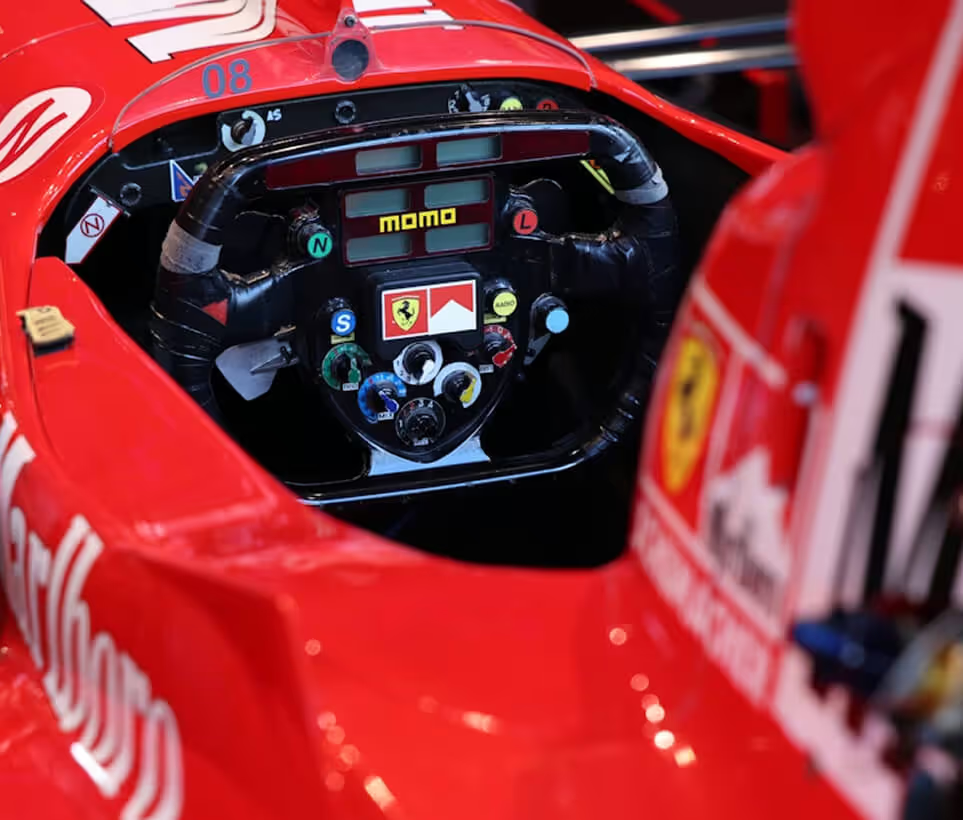
Instead of a physical pedal, F1 cars use electro-hydraulically controlled paddle shifters located right behind the steering wheel. It is controlled through clever paddle mechanisms and electronics on the steering wheel.
These are the little beauties that let drivers shift gears in milliseconds — faster than you can say “Max Verstappen leads again!”
This system, called a semi-automatic sequential gearbox, allows drivers to shift up or down one gear at a time using paddles — right paddle for upshifts, left for downshifts. No clutch pedal, no gear stick, and definitely no grinding noises like the one your cousin makes in his Swift when learning manual.
Let’s take a full lap around how the system actually works, why the clutch pedal vanished, and what’s going on behind those insane, blink and you miss it gear changes.
The F1 Paddle Shifter: Smarter Than You Think
Now, here’s where things get really interesting. Formula 1 steering wheels have two clutch paddles — not for changing gears mid-race, but mainly for launches and pit stops.
At the race start, the driver uses these paddles to carefully release the clutch and find what’s called the “bite point.” Getting this wrong can mean losing several positions off the line. Getting it right? Pole position glory awaits.
Fun fact — Ferrari was the first team to introduce this technology back in 1989 with the Type 640 car. This innovation made traditional clutch pedals vanish from F1 for good, as other teams quickly realised it gave drivers lightning-fast gear changes and better control.
So yes, you can thank Ferrari next time you see a driver flicking through gears as smoothly as scrolling your Instagram feed.
How Many Pedals Do F1 Cars Have?
In a normal manual road car, you get three pedals: clutch, brake, and accelerator. In a Formula 1 car, life is simpler: only two pedals – throttle and brake.
The clutch is still there, but instead of a pedal near the driver’s left foot, it’s controlled using small clutch paddles behind the steering wheel, usually operated with the driver’s fingers. This allows drivers to keep both feet focused on braking and acceleration while their hands manage the rest.
For Indian readers used to navigating bumper to bumper traffic with constant clutch work (if you are still driving your dad's old car), this alone feels like an upgrade from pain to perfection.
How Do F1 Pedals Work
(Video Courtesy - Mercedes-AMG Petronas Formula One Team )
The Evolution of F1 Transmission Technology
The journey from clutch pedals to today’s lightning paddle shifts is pure motorsport genius.
- 1950s–1980s: Traditional manual gearboxes with clutch pedals. Drivers like Ayrton Senna had to heel-and-toe at 300 km/h!
- 1989: Ferrari introduces the first semi-automatic gearbox. Revolution begins.
- 1990s: Every team adopts paddle shifters for faster, more reliable performance.
- 2008 onwards: FIA standardises transmissions — all modern F1 cars now use eight forward gears with mechanical clutches, not fully automatic ones. This ensures the driver’s skill remains key.
How the F1 Clutch System Actually Works
Even without a clutch pedal, F1 cars still have a clutch. And it’s nothing like what you’d find in your car.
- F1 cars use multi-plate carbon fibre clutches, built to handle over 1000 horsepower from hybrid engines.
- The electronic control unit (ECU) manages clutch engagement in microseconds.
- These systems are semi-automatic, meaning the driver initiates gear shifts via paddles, but the ECU ensures each change happens at the perfect torque and RPM.
The result? Gear shifts that happen in just 50 to 100 milliseconds — faster than most high-end road cars that use dual-clutch transmissions.
Why F1 Drivers Still Need Clutch Control
“Wait,” you might say, “if the car does most of the work, what does the driver even do?”
A fair question — but the driver still needs superb manual clutch control at certain points, like:
- Race starts: To modulate traction and avoid wheelspin.
- Pit stops: To shift smoothly from neutral to first gear.
- Recoveries: If the car stalls or goes off track.
There’s no automatic launch control in F1 (banned by regulations), so drivers rely on skill, reflexes, and nerves of steel to time everything to perfection. As former world champion Jenson Button once joked, “Getting the start right is like balancing a pencil on your finger while someone sets off fireworks next to you.”
The Tech Behind the Speed
Modern F1 clutch systems are marvels of engineering:
- Multi-plate carbon fibre design for durability and lightness.
- Integration with Energy Recovery Systems (ERS) and engine mapping.
- Controlled via electro-hydraulic actuators for precision performance.
It’s not just about speed — it’s about reliability under extreme stress, something that separates F1 engineering from everything else on four wheels.
So no, F1 drivers don’t have a clutch pedal, but their hands are doing the work of all three pedals, with the coordination of a world-class drummer on espresso.
Why Modern F1 Cars Don’t Use A Traditional Clutch Pedal
Early Formula 1 cars did use a proper clutch pedal and traditional manual gearboxes, much like performance road cars. Drivers had to lift off the throttle, press the clutch, slot the next gear, and then release everything smoothly – all while dealing with high G forces.
As speeds increased and technology evolved, teams realised that:
- Every manual action by the driver cost valuable milliseconds.
- Taking a hand off the wheel to change gears reduced control and increased risk.
By the late 1980s and early 1990s, semi automatic sequential gearboxes with steering wheel paddles started to appear, with Ferrari playing a famous early role in popularising them.
This change meant:
- No need for a traditional clutch pedal during normal driving.
- Gear changes became partially automated and much faster.
- Drivers could keep both hands on the wheel at all times.
Basically, F1 chose speed, safety, and stability over tradition. Somewhere, an old-school purist still cries softly into a manual gear knob.
How F1 Paddle Shifters And Semi Automatic Gearboxes Work?
Modern F1 cars use a semi automatic, sequential gearbox with eight forward gears and one reverse, as mandated by FIA regulations.
Here’s the flow in simplified terms:
- The right paddle behind the steering wheel commands an upshift.
- The left paddle commands a downshift.
- The gearbox is sequential, meaning drivers move through gears in order – no jumping from 8th straight to 3rd like in a road car H pattern.
Once the driver taps a paddle:
- Sensors detect the input.
- The car’s ECU (Electronic Control Unit) and hydraulic actuators handle clutch engagement, ignition, and torque control automatically.
- The actual gear change completes in around 30–50 milliseconds, sometimes even faster in seamless-shift designs.
For context, a blink is roughly 300 milliseconds. A good dual clutch road car might shift between 100–200 milliseconds. An F1 gearbox is playing in a completely different league.
No wonder drivers can rack up 3,000+ gear changes in a single Grand Prix without their left leg threatening to resign.
Role Of The F1 Clutch System At Race Starts
If most gear changes are handled automatically, when does the driver actually use the clutch?
The main moment: race starts. This is where the magic – and the stress – happens.
On the starting grid, the driver:
- Pulls and holds the clutch paddles behind the wheel.
- Applies throttle to bring engine revs into the ideal launch window.
- Releases the clutch paddles with extreme precision to find the bite point, balancing traction and power.
Too aggressive and the wheels spin; too cautious and rival cars fly past before Turn 1. Modern rules limit the electronics that can assist at the start, so a lot of performance still depends on the driver’s timing and feel.
That perfect launch you see? It’s the result of simulation, practice, muscle memory, and nerves of steel – not fully automatic launch control.
How an F1 Clutch Works
(Video Courtesy - Driver61)
Why Clutch Control Still Matters In F1
Apart from race starts, drivers use the clutch paddles during:
- Pit stops: When stopping and then pulling away from the pit box cleanly.
- Slow manoeuvres: During formation laps, out laps, or if they need to recover from a spin or stall.
Even though the clutch pedal is gone, fine clutch control is still a critical driver skill, especially with:
- Very small clutch diameter (often under 100 mm).
- Extremely sensitive engagement behaviour.
Think of it as doing delicate surgery with boxing gloves on – while the world is watching and timing you to the thousandth of a second.
F1 Multi Plate Clutch v/s Normal Car Clutch
In your regular manual car, you usually have a single plate friction clutch. In an F1 car, the clutch is a multi plate carbon fibre unit, designed to cope with brutal torque, extreme temperatures, and frequent starts.
Key differences:
- Number of plates: F1 clutches typically use multiple small friction and steel plates stacked together, which increases the total friction area without making the unit physically huge.
- Materials: Carbon based, lightweight, and heat resistant materials instead of the more conventional organic or metallic linings in road cars.
- Size and weight: Very compact and light; some F1 clutch assemblies weigh around or below 1 kg with diameters under 100 mm.
- Torque capacity: Designed to handle power outputs of 700+ hp in older eras and well over 900–1000 hp in current hybrid setups.
Multi plate clutches offer:
- Better heat dissipation.
- Faster engagement and disengagement.
- Higher torque capacity in a smaller package.
It’s like comparing a basic household mixer to an industrial kitchen machine – both mix, but one is built to survive a restaurant rush.
How Fast Do F1 Cars Change Gears?
Gear changes in a modern F1 car are ridiculously fast:
- Many sources estimate shift times around 30–50 ms for upshifts.
- Some seamless-shift gearbox designs can drop this into the single digit millisecond range for torque interruption.
Meanwhile, high end dual clutch road cars typically shift in the 100–200 ms window, and traditional manuals are much slower due to human movement and pedal/clutch timing.
All of this means:
- Minimal loss of power during shifts.
- Smoother acceleration out of corners.
- Less disturbance to the car’s balance mid corner.
On tight circuits where lap times are separated by tenths or hundredths, that “instant” shift is a massive competitive advantage.
F1 Transmission And Gearbox Rules
The FIA keeps tight control over what teams can do with transmissions to maintain safety, cost control, and some level of technical parity.
For recent and upcoming seasons, regulations specify that:
- Cars must use an 8 speed (plus reverse) semi automatic, sequential gearbox.
- The clutch must be mechanically actuated, not fully automated in a way that removes the driver’s role at starts.
- Gearbox designs and lifetimes are regulated to limit how often teams can change them, with penalties for unscheduled changes.
Teams still have room to innovate in:
- Clutch pack design and materials (within safety constraints).
- Control algorithms – how quickly and smoothly gear shifts are managed.
- Calibration of the bite point and launch maps for each driver.
So while on the surface all F1 cars “just” have paddles and 8 gears, under the skin the clever details still make a noticeable difference.
What Happens If The Paddle System Fails?
If the main paddle shift system fails mid race, things can get ugly very fast.
Depending on the design and the nature of the failure:
- Drivers may have access to backup shift modes that allow more basic, slower gear changes.
- In many cases, serious gearbox or hydraulic issues still lead to retirement, because the car can no longer shift reliably or safely.
Given how integrated the gearbox is with engine control, hybrid systems, and hydraulics, a transmission failure often takes out the whole package. If you’ve ever seen a car stuck in one gear crawling back to the pits – that’s usually a transmission or hydraulics nightmare unfolding in real time.
Final Lap Thoughts
So the next time you’re driving and swearing at traffic on the Pune-Bangalore Highway, remember — even F1 drivers don’t have a clutch pedal anymore. But they do have some of the most advanced transmission systems on the planet, combining human reflexes with cutting-edge tech.
Formula 1 remains the perfect blend of man and machine, proving once again that innovation doesn’t always mean adding more — sometimes, it means removing a pedal.
FAQs: F1 Clutch, Pedals and Gear Shifting
Q1. Do F1 cars have a clutch pedal like normal cars?
No. Modern F1 cars do not have a traditional clutch pedal. Instead, they use hand operated clutch paddles behind the steering wheel, while the ECU and hydraulics manage most clutch actions during gear shifts.
Q2. Do F1 cars still have a clutch at all?
Yes. Every F1 car has a multi plate carbon clutch located between the engine and gearbox, crucial for transmitting power and controlling starts, even though there is no foot pedal.
Q3. How fast do F1 cars change gears compared to road cars?
F1 cars can complete a gear change in roughly 30–50 milliseconds, with seamless-shift designs minimising torque interruption even further. High performance road cars with dual clutch systems are quick but usually slower than F1 gearboxes.
Q4. When do F1 drivers manually control the clutch?
Mainly during race starts, pit lane departures, and low speed manoeuvres such as leaving the grid or recovering after a spin. During normal racing, shifts are initiated by the driver via paddles, but clutch engagement itself is automated.
Q5. How many pedals does an F1 car have?
Modern F1 cars have two pedals: brake and accelerator. The clutch is operated by hand controlled paddles, not a third foot pedal.
Q6. Can F1 drivers skip gears, like going from 8th to 5th directly?
No. The gearbox is sequential, so drivers must move one gear at a time in either direction. Rapid downshifts are still extremely fast but follow the sequence.
Q7. Are all F1 clutch systems the same between teams?
The basic concept is similar – multi plate racing clutches with paddle control – but teams design their own hardware details and control software, leading to differences in feel, reliability, and launch performance.
How Different are Formula 1 and Road Car Clutches?
(Video Courtesy - Driver61)
If you’ve ever watched a F1 race and wondered, “Wait, where’s the clutch pedal?” — you’re not alone.