

Remember when your mom told you to stop eating samosas and hit the gym? Well, the FIA just told Formula 1 cars the exact same thing. And honestly? They needed it.
The 2026 F1 season is bringing massive changes to how these machines look and perform, and I'm here to break down what's actually happening without the boring technical jargon. Spoiler alert: these new cars are going to be smaller, lighter, faster, and way more fun to watch race.
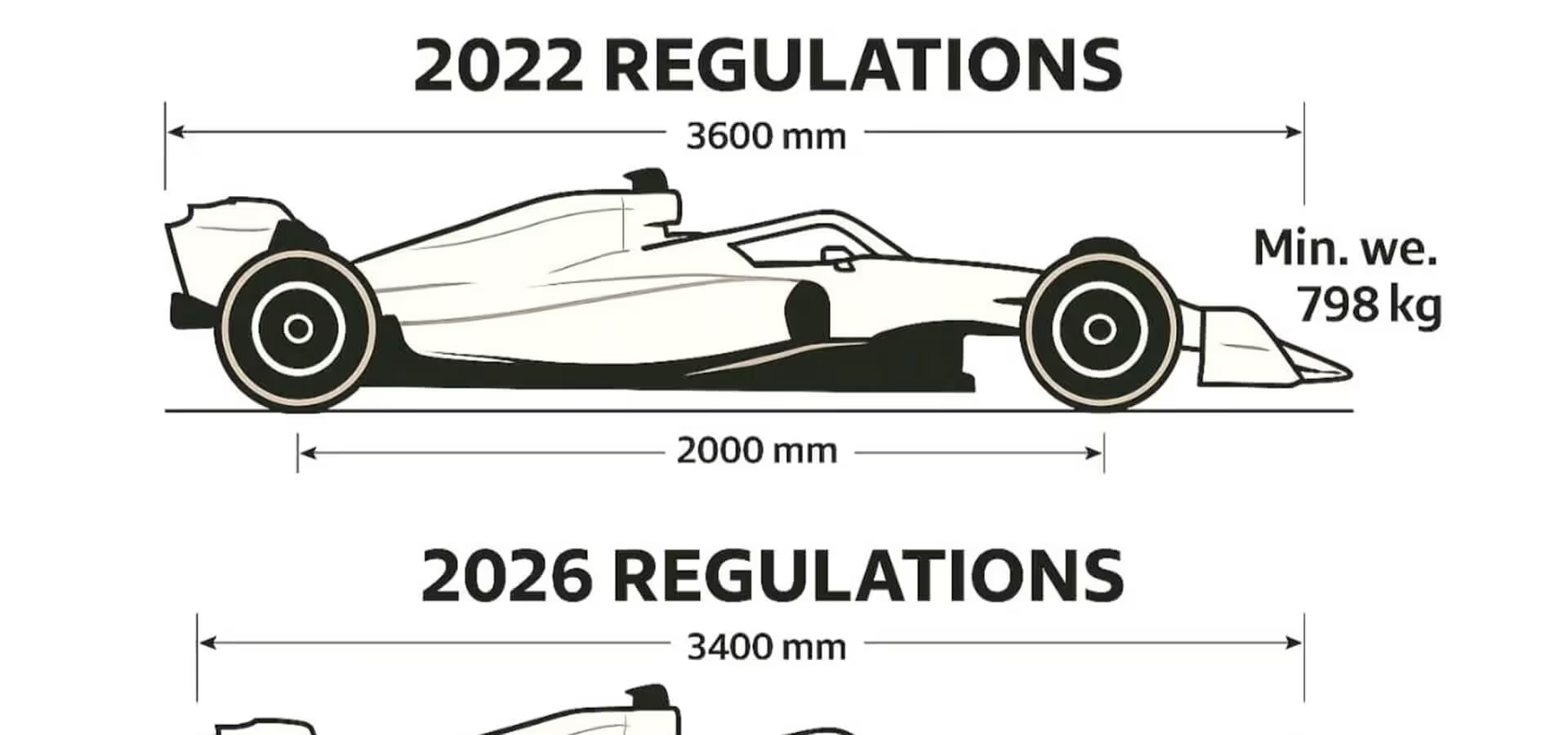
Imagine your favorite F1 car going on a crash diet. The new 2026 regulations have slashed the wheelbase (that's the length, for the non-gearheads) by 200mm. To put this in perspective, that's about the size of your average reusable water bottle – the one you bought to feel eco-conscious but only used twice before going back to plastic.
The width has been trimmed by 100mm too (roughly the length of a chocolate bar, which honestly sounds like the most F1 way to measure anything), bringing it down to 1900mm. Even the floor width got a trim of 150mm. These cars are basically going full-minimalist aesthetic now.
The bottom line? 2026 F1 cars will be more agile, easier to maneuver, and less like trying to park a bus in Mumbai traffic.
(Video Courtesy - The Race)
Here's where it gets really interesting. The FIA managed to shed a whopping 30kg from these machines compared to 2022 models. That's equivalent to removing an adult dalmatian from the car – which is a very specific way to measure weight, but we're rolling with it.
The new cars will weigh just 768kg total (722kg car + 46kg tyres estimated). If F1 cars were trying to get in shape for a Bollywood movie, this would be their big transformation moment.
Why does this matter? Lighter cars mean better acceleration, sharper handling, and a whole lot more racing action. Less mass to throw around = more precise driver control. Think of it like the difference between driving a fully-loaded SUV and a lightweight hatchback through Bangalore traffic.
The engineers have been pretty clever here. They've cut downforce by 30% and reduced drag by 55%. Now before you think "less grip = slower cars," that's not quite how it works.
The goal is efficiency and handling – basically making cars that stick around better when they're close together without creating this massive invisible bubble of air that makes overtaking impossible. It's like finally being able to follow that car in front of you without feeling like you're trying to push through a wall of invisible force.
Good news and bad news situation here. The 18-inch wheels that were introduced in 2022 are sticking around (so no radical changes there). But there are some tweaks that matter.
Front tyres are 25mm narrower and rear tyres are 30mm narrower. This will reduce weight slightly, and according to Pirelli, there will be "minimal loss" of grip. Translation: the tyres will still grip like they mean it, they'll just do it while being lighter and more efficient.
Mario Isola, the Pirelli motorsport boss, mentioned they're expecting to save around 5kg per set of four tyres. That might not sound like much, but in F1, every gram counts. It's like saving 5kg in groceries on your monthly bill – small wins add up.
Now, this is where things get genuinely exciting. Remember the DRS system that lets drivers open their rear wing on straights? Imagine that but on steroids.
The 2026 F1 cars will have movable front and rear wings that drivers can actually control during the race. Here's how it works:
Z-Mode (Standard Setup): The wing elements open and angle themselves to give the car maximum downforce. This is your high-grip, high-speed-corner mode. The car will be a proper racing machine in this mode.
X-Mode (Low-Drag Setup): The flap angles change on both front and rear wings to maximize straight-line speed. Drivers activate this on straights to gain that precious extra speed without losing their minds about aerodynamic instability.
The FIA is planning to make X-mode available on any straight that lasts longer than three seconds. This isn't just a gimmick either – it genuinely should help with overtaking because cars won't be creating that wall of turbulent air that makes following nearly impossible.
Real talk? This is basically F1 finally admitting that having cars follow each other more easily might actually make racing better. Revolutionary, I know.
The FIA isn't just stopping at active wings. They're also removing front wheel arches entirely and mandating specific wheel bodywork to improve "wake performance." Basically, they're trying to clean up the messy air that comes off the wheels so the car behind can actually breathe.
There will also be in-washing wheel wake control boards on the front of the sidepods. Yes, that's a real name. No, I don't fully understand it either, but apparently it helps control the air coming off the wheels.
The floor is going "partially flat" and the diffuser is getting less power. This is the FIA's way of saying "let's make the ground effect less crazy so teams aren't struggling with bouncing and porpoising like they're riding a mechanical bull at a nightclub."
Let's not forget that F1 cars also need to, you know, protect the driver if something goes wrong.
The FIA has redesigned the front impact structure with a two-stage setup to prevent the FIS from snapping off near the survival cell during crashes. Side intrusion protection around the cockpit has been beefed up, and the protection around the fuel cell has more than doubled.
Best part? They did all this without adding any weight. That's some seriously smart engineering right there.
Roll hoop loads have been bumped from 16G to 20G (matching other single-seater formulas), and test loads have increased by 26kN to 167kN. There's also new lateral safety lights to show the ERS (Energy Recovery System) status when a car stops on track, helping protect both drivers and marshals.
The 2026 regulations are basically F1's way of saying "let's make racing actually exciting again." Smaller cars that are easier to handle, more efficient aerodynamics that don't create walls of dead air, and movable wing elements that give drivers more tools to overtake.
These aren't revolutionary changes – they're evolutionary improvements aimed at one thing: letting drivers race each other more closely and actually pass each other without it being a complete lottery.
The verdict?
2026 should be pretty interesting. The cars might be smaller on the outside, but they're getting smarter on the inside. And really, isn't that what we all want – a more agile, efficient machine that's actually fun to watch?
Time to mark your calendars for 2026. This is going to be good.
(Video Courtesy - Formula Addict)
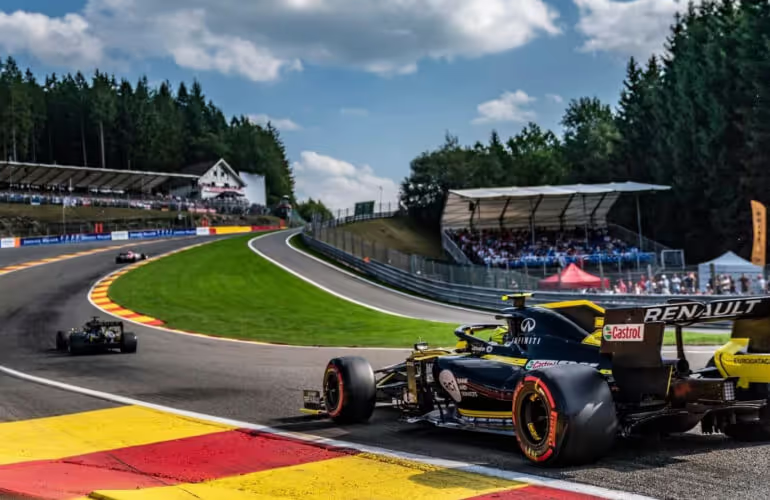
An old-school circuit, with fast, flowing and dangerous racing


Travel to the most popular locations on the calendar to experience an F1 race






Leave a Comment