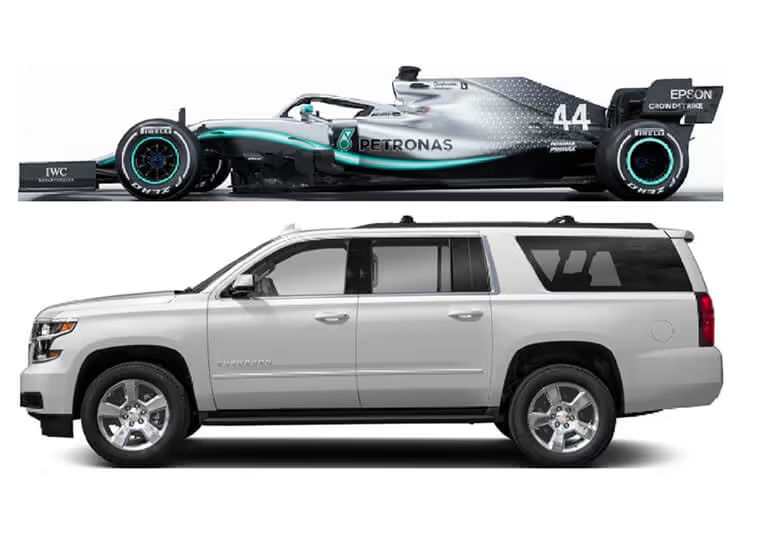
Remember when your mom told you to stop eating samosas and hit the gym? Well, the FIA just told Formula 1 cars the exact same thing. And honestly? They needed it.
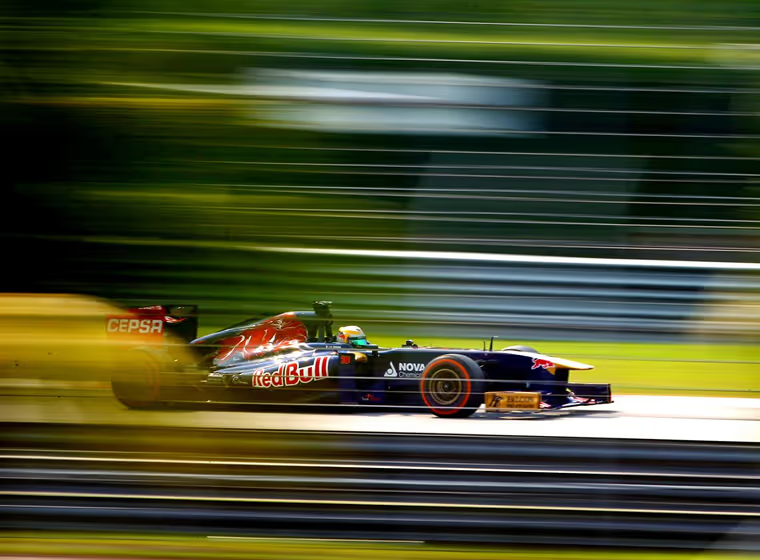
The 2026 F1 season is bringing massive changes to how these machines look and perform, and I'm here to break down what's actually happening without the boring technical jargon. Spoiler alert: these new cars are going to be smaller, lighter, faster, and way more fun to watch race.We all see those sleek F1 cars zooming around at 300+ km/h looking absolutely gorgeous on the track. But have you ever wondered how teams actually get those stunning paint jobs on their race cars?
It's not just about grabbing a paint brush and going "vaish vaish" like you might do on your scooter back home. Buckle up – we're about to dive into the surprisingly complex world of Formula 1 car painting!
The Big Picture: F1 Livery is Way More Than Just Paint
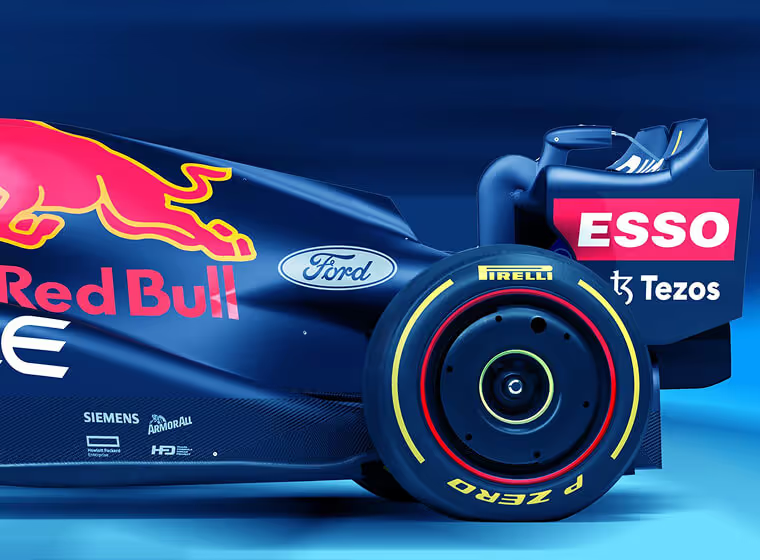
Here's the thing: those distinctive designs you see on F1 cars aren't just there to look pretty (though they absolutely do). Every F1 livery is basically a mobile billboard that travels the globe, promoting sponsors and representing team identity. It's like your neighborhood's dhaba finally got a professional logo design – except this logo costs millions and goes 340 km/h.
At Alpine's paint shop in Enstone, England, a dedicated team of 10 professionals work year-round to make sure those cars look absolutely mint. And trust us, the process is way more intricate than you'd think.
Part 1: The Design Phase – Where the Magic Starts
Before a single drop of paint hits a carbon fiber chassis, the design and marketing teams spend months – sometimes over a year – dreaming up the livery. They're not just throwing colors together randomly (though that's what it sometimes looks like when you're watching from the stands).
What goes into this brainstorming session?
- The team's brand identity (think of it like creating a unique personality for the car)
- Sponsor requirements (because let's be honest, sponsors are basically running the show)
- How the design will look in-person at the track
- How it'll look on TV screens across India and the world
- What the design looks like from different angles and under various lighting conditions
The designs are tested extensively on digital screens to ensure they pop on television. Why? Because millions of F1 fans watching from home are part of the equation. If your livery doesn't look good on a 2D screen, you've basically failed the entire exercise.
Watch How Red Bull Racing Team Paints Their F1 Car
(Video Courtesy - Red Bull Racing Team)
Part 2: From Digital Dreams to Physical Reality
Once the design is finalized, the real work begins. The paint shop receives the initial renders and has to figure out one critical question: How do we actually paint this thing?
"We have some test panels, and we learn as we go," explains Alpine's Head of Supply Chain, Ian Pearce. "We're trying to achieve the right color with the lightest possible weight. Every gram matters in F1!" (read that again, "every gram matters")
Here's where it gets interesting (and slightly chaotic): F1 cars aren't solid objects. They're made of individual panels that fit together. Sometimes the design looks perfect on a computer, but when you try to paint it across actual car panels with split lines and joins, things get... complicated.
The panel problem: Imagine trying to draw a straight line across multiple pieces of paper without them matching up perfectly. That's what the paint team deals with daily. If panels don't line up correctly, fans and TV cameras will spot it immediately. It's basically the F1 equivalent of a failed home paint job where you can see all the mistakes from across the room.
Part 3: The Paint Shop Chronicles – Breaking Down the Process
This is what actually happens when panels arrive at the shop:
Step 1: Preparation (aka the boring but crucial stuff)
First, they receive bare carbon fiber panels – basically unpainted, naked components. The team has to:
- Mask out areas that will stay bare carbon (yes, modern F1 cars intentionally leave sections unpainted to save weight)
- Fill any imperfections with black composite filler
- Sand everything until it's smooth (using 320-grit, then 500 or 800-grit paper)
It's like preparing your walls before painting your flat. You can't just slap paint on imperfections and hope nobody notices.
Step 2: The Primer Treatment
- Two-pack primer is applied
- Everything gets rubbed down again with 320-grit paper
- Then finer sanding with 500 or 800-grit paper (because tiny scratches ruin everything)
Step 3: The Actual Paint
- Two coats of metallic base coat (the fun part!)
- One coat of matte lacquer
And boom – you've got a painted F1 car component.
Part 4: The Vinyl Wrap Revolution – Modern F1's Better Idea
Here's where Alpine innovated: instead of just painting everything, they largely switched to vinyl wraps.
Why? Simple: weight savings.
In Formula 1, every single gram matters. Paint adds weight. Vinyl wraps add weight too, but they add weight more consistently throughout the season. With paint, teams were continuously adding weight as they refreshed and repainted components. Vinyl solves this problem.
But here's the catch: Vinyl wrapping is actually MORE demanding than painting.
"With paint, you can hide imperfections," Pearce explains. "With vinyl, you absolutely cannot. Every tiny flaw in the underlying carbon fiber shows through. It's like wearing a tight t-shirt when you're not exactly gym-ready – everything becomes visible!"
The vinyl has to fit perfectly against the carbon fiber contours. It's precision work at a microscopic level. One misaligned section, and your multi-million-dollar F1 car looks unprofessional on TV. No pressure, right?
Part 5: The Temperature Nightmare – Vegas vs Qatar
Here's something nobody talks about: ambient temperature destroys F1 paint jobs.
The Vegas problem: It's 6°C at night in Las Vegas. When technicians try to apply vinyl in such cold conditions, the backing paper basically turns to "jelly," The adhesive doesn't work properly. Everything becomes a nightmare.
The Qatar problem: It's 30°C. The vinyl becomes too sticky and difficult to apply precisely.
It's like trying to make perfect rotli at high altitude in Himachal – conditions matter way more than you'd expect.
The paint shop has to constantly adapt their techniques based on local conditions at each Grand Prix venue. They can't just apply the livery in the controlled factory environment and hope it works worldwide.
How To Design An F1 Livery
(Video Courtesy -Mr. V's Garage)
Part 6: Special Liveries – The Fun (but Stressful) Part
Remember when Alpine ran a Deadpool-themed livery at the Belgian Grand Prix in 2024? Or the Indiana Jones design at the US Grand Prix? These one-off liveries are marketing gold but logistical nightmares.
"Spa was a nightmare from a practical standpoint," Pearce admits. "You've got three options of front wings, three options of rear wings, four options of cooling bodywork... and they ALL have to be wrapped in the special livery."
Why? Because if it rains during practice but you've only wrapped the dry-weather setup, you're stuck. The engineers might need a different cooling configuration, but it won't match the livery. Unacceptable.
So the paint team has to prepare every single possible configuration. For one race. In a unique color scheme. This is the definition of "over the top" – but this is F1, so it's basically business as usual.
Part 7: The Never-Ending Refresh Cycle
Here's the thing nobody realizes: F1 paint jobs aren't just done once. They're refreshed constantly throughout the season.
Why? Aerodynamic damage and wear.
During a race, the leading edges of wings get sandblasted by dirt and stones. By race end, the vinyl is peeling, scratched, and damaged. Not only does this look terrible, but it destroys aerodynamic efficiency. So before the next race, the entire livery gets stripped and replaced.
This happens every few Grand Prix races. Which means the paint shop is traveling around the world constantly, replacing liveries at circuits. It's cheaper to do this at the track than to ship panels back to England.
"Some parts of the car get absolutely sandblasted," Pearce explains. "Especially at dusty circuits like Bahrain and Qatar. The vinyl acts as a protective layer for the carbon fiber underneath. Once that's gone, you risk damaging the actual car components."
Part 8: The Secret Garage – Show Cars and Launch Cars
Before a new season launches, everything is kept secret. The paint shop wraps show cars in the new livery, but these can't be seen until the official launch. They're covered up like they're hiding state secrets.
"Everything needs to be kept covered – even from people here at the factory – because it's all top secret," Pearce says. "We can't show anything in the old livery once the new livery has launched. No exceptions."
This means the paint team is simultaneously working on race cars, spare parts, pit equipment, factory equipment, tool boxes, and show cars – all in different stages of production, all needing precision work, and all requiring absolute secrecy until launch day.
It's like preparing for a giant surprise party, except the surprise is a 1000-horsepower race car, and the consequence of leaking details is millions of rupees in lost marketing value.
Part 9: The Weight Question – Why Bare Carbon Exists
You might wonder why modern F1 cars have all that bare carbon fiber showing. It's not a design choice; it's physics.
The 2005 championship-winning Renault R25 was painted almost entirely. Beautiful. But modern F1 is obsessed with weight reduction. Every gram saved = potential advantage. Alpine's 2024 car launched overweight and gradually got lighter as the season progressed – with more paint being added back as weight was saved elsewhere.
It's a constant balancing act: Look beautiful on TV vs. Stay lightweight for performance.
Guess which one usually wins? Yep, the lightweight option.
Part 10: The 2026 Challenge – New Regulations, New Headaches
Formula 1 is introducing three pre-season tests in 2026 instead of the usual schedule. This means the off-season gets shorter. The paint team has to front-load their work into December instead of January.
Pearce is already stressed about this, and the regulation change hasn't even happened yet. It's like being told you need to paint your house, but you've got 30% less time – and the paintwork has to be flawless for a TV broadcast.
The Bottom Line: Why F1 Paint Jobs Are Insanely Complicated
At the end of the day, painting an F1 car isn't just about making it look pretty. It's about:
- Balancing weight requirements with visual impact
- Ensuring consistency across dozens of components
- Handling temperature extremes across three continents
- Managing sponsor requirements and brand identity
- Protecting aerodynamic surfaces from damage
- Keeping everything secret until launch day
- Maintaining equipment and show cars year-round
- Constantly refreshing liveries to maintain performance and aesthetics
It's precision engineering meets artistic vision meets logistical chaos.
Pearce sums it up best: "The one-off liveries were amazing. To see that design come to life and then see it go around the track? Yeah, it's totally amazing. Even when you're flipping the car backwards and forwards during the process, it's just a massive achievement."
So next time you're watching an F1 race on your screen, take a moment to appreciate those gorgeous liveries.
There's a whole team of dedicated technicians working year-round, traveling the world, and dealing with impossible challenges to make sure those cars look absolutely stunning – even if nobody fully realizes what goes into it.
Because in Formula 1, even the paint job is an engineering masterpiece. Welcome to the high-octane world of F1 paint shops – where precision, perfection, and a little bit of controlled chaos create rolling works of art that do 300+ km/h.
Want to know more about F1? From car design to pit strategy, we've got all the details that make Formula 1 the most fascinating sport on the planet.
Stay tuned for more insider looks at how teams push the boundaries of speed and technology!
Watch How F1 Cars Are Painted
(Video Courtesy - F1 Education)
Buckle up – we're about to dive into the surprisingly complex world of Formula 1 car painting!