

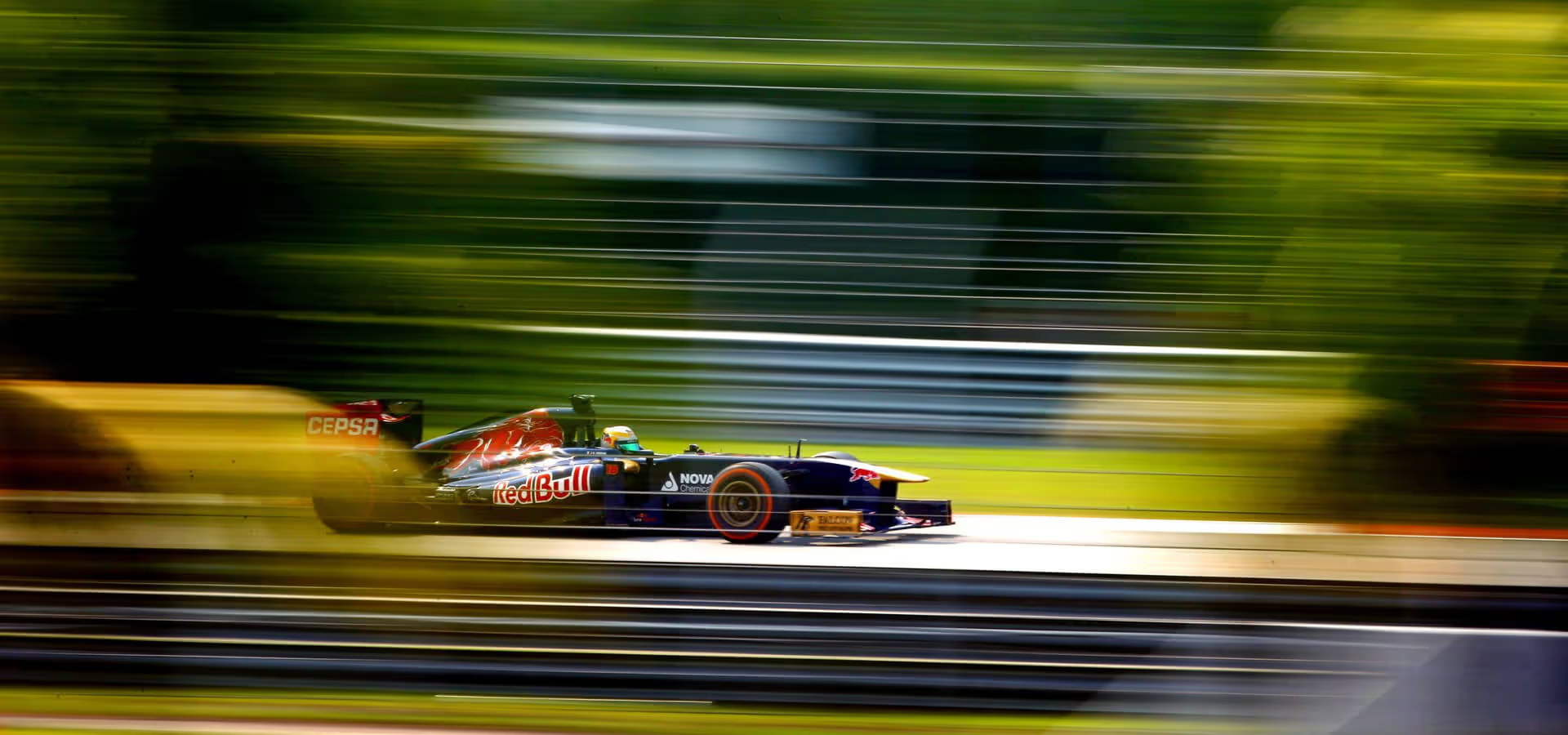
Ever wondered what it would feel like to be in a car that goes from 0 to 60 mph faster than you can say "Valtteri, it's James"? Welcome to the mind-boggling world of Formula 1 speeds. Let me tell you, if you think your car's 0-100 acceleration is impressive, wait till you hear what these F1 rockets can do.
Let's cut to the chase. Formula 1 cars hit speeds that would make even the most powerful supercars weep into their designer fuel tanks.
During an actual Grand Prix race, F1 cars max out at around 220 mph (354 km/h) on the longest straights. But here's the plot twist—the official race record stands at a jaw-dropping 372.5 km/h (231.4 mph), set by Valtteri Bottas way back in 2016 at the Mexican Grand Prix. The dude basically weaponized thin air and elevation advantage to create a speed that makes jet engines jealous.
And if you think that's fast? Bottas actually hit 378 km/h (234.9 mph) during qualifying in Baku that same year. Still unofficial, but absolutely bonkers. More recently, Franco Colapinto took a stab at it in 2024, clocking 356.4 km/h (221.4 mph) at Las Vegas—respectable, but let's be real, Bottas flexed harder.
The craziest part? Back in 2006, Honda took their RA106 to the Bonneville Salt Flats (basically a massive salty runway in the middle of nowhere) and achieved a mind-melting 397.36 km/h (246.9 mph). That's literally faster than many aircraft!
Now, if you think top speed is impressive, wait till we talk about acceleration. Remember how your car takes like 10 seconds to go from 0-60? Yeah, F1 cars do it in about 2.1 to 2.7 seconds—and some do it in a ridiculous 1.6 seconds.
Here's a fun fact: your expensive sports car probably can't do what these machines do in a heartbeat. Modern F1 cars can accelerate from 0 to 100 mph in less than 4 seconds. We're talking about technology so advanced that it makes your smartphone look like a Nokia 3310.
Even more insane? They can go from 60 to 120 mph (97 to 193 km/h) in just 1.9 seconds. That's when things get really spicy.
Here's the thing that separates F1 from other racing series: it's not just about going in a straight line like some amateur drag racer. F1 is all about maintaining ridiculous speeds through corners where normal cars would either crash or slow down dramatically.
Thanks to sophisticated aerodynamics and something called "downforce," F1 cars can corner at speeds that would seem absolutely insane. At about 120 mph (190 km/h), the aerodynamic downforce can actually be double the car's weight, pressing it into the track like a suction cup. This means drivers can take corners at speeds that look impossible on TV.
The catch? This creates absolutely punishing G-forces. Drivers experience:
To put this in perspective, astronauts experience around 3 Gs during shuttle launch. F1 drivers are basically doing astronaut training every single weekend, except they're sitting in a tight cockpit at 200 mph while sweating buckets in a fireproof suit.
Okay, so IndyCars and MotoGP bikes can hit similar top speeds on straights, but here's where F1 dominates: overall lap time.
Take the Circuit of the Americas in 2019:
That's over 14 seconds faster! When you're talking about racing, that's literally an entire lap difference.
At Monaco (one of the trickiest circuits on the calendar), Charles Leclerc's fastest lap was a smooth 1:10.346. These times exist because F1 cars can maintain speed everywhere—straights, tight corners, chicanes, everything.
1. Aerodynamics That Would Make a Falcon Jealous
Every single surface on an F1 car is designed to either push air or create downforce. The front wing, rear wing, floor, diffuser—it's like the car is having a constant conversation with the air around it.
The DRS (Drag Reduction System) is basically the car's secret weapon. When activated on straights, it reduces drag and gives drivers up to a 10 mph speed boost, which might not sound like much, but in racing, that's the difference between overtaking and getting lapped.
2. Hybrid Engines That Pack 1,000+ Horsepower
Modern F1 engines are 1.6-liter V6 turbocharged beasts combined with sophisticated Energy Recovery Systems (ERS). These systems capture wasted energy from braking and the exhaust, store it, and then release it as extra power when needed.
The result? Over 1,000 horsepower from an engine smaller than what your regular sedan uses. It's like fitting the heart of a monster truck into a car that weighs less than a Maruti Swift.
3. Tires That Cost More Than Most Motorcycles
F1 uses special Pirelli tires that are light-years ahead of what's on your road car. Teams can choose between soft compounds (grippier but wear faster) and hard compounds (last longer but less grip).
The difference between the right tire choice and the wrong one? An entire race victory or a catastrophic finish.
4. Carbon Fiber Everything
F1 cars are constructed from materials so advanced that NASA probably wants to know their suppliers. Carbon fiber makes them strong yet incredibly light. The minimum weight for an F1 car is now 798 kg (dropping to 768 kg in 2026), which is about as heavy as a fully grown elephant... that can do 0-60 in 2.6 seconds.
5. Track Design Matters Massively
The shape and elevation of the track dramatically affect speeds. Mexico City sits at 7,500 feet above sea level, meaning thinner air = less drag = faster speeds. That's why the speed records keep getting set there. Meanwhile, Monaco is so tight and technical that even with all that power, lap times stay relatively slow.
Let me paint you a picture. Imagine being pressed into your seat with the weight of 6 grown men sitting on your chest while your car brakes from 200 mph. That's what happens when these drivers hit the brakes. Their neck muscles need to be strong enough to hold up their head against forces that would literally flip an untrained person unconscious.
This is why F1 drivers are absolute physical specimens. They're not just sitting there steering; they're fighting G-forces that would make most of us pass out. And they do this for 90 minutes straight, while making split-second decisions that determine if they win or crash into a wall.
The introduction of hybrid power units in 2014 was revolutionary. Before that, F1 cars were using naturally aspirated V8 engines that screamed at 20,000 RPM but were less efficient. The hybrid revolution made cars faster, more efficient, and more eco-conscious. Yes, these 200 mph+ machines are actually getting greener.
New materials like advanced carbon composites and computer simulations have made every design choice surgical in its precision. Teams use massive wind tunnels and supercomputers to shave microseconds off lap times.
The FIA (Formula 1's governing body) is making big changes. In 2026, engines will use 100% eco-friendly fuel and electric systems will provide almost 50% of the total power. The engine will still be a V6, but the electric component will be significantly more powerful.
This is actually a good thing for speed—imagine already-fast cars getting even more electric torque. It's like upgrading from a Tesla Model 3 to a Tesla Roadster, but for F1.
You might think F1 cars would be infinitely faster, but the FIA (Fédération Internationale de l'Automobile) has strict rules that deliberately limit speeds. Here's why:
Current rules limit things like engine fuel flow, maximum downforce levels, and aerodynamic shapes. These are the guardrails keeping F1 from becoming a game only played in hospital beds.
With all this speed comes the need for serious safety. Modern F1 cars are fortresses:
The sport has come a long way in terms of safety, and it shows. Despite the extreme speeds, modern F1 is remarkably safe compared to decades past.
IndyCars can hit similar or even slightly higher top speeds on oval tracks (hitting 380+ km/h), but F1 cars are faster over a complete lap thanks to superior cornering speeds.
MotoGP bikes are absolutely incredible machines, but they can't match F1's lap times even when top speeds are similar. At Austria's Red Bull Ring in 2023, Max Verstappen's F1 lap was 1:04.391 while MotoGP's top rider needed 1:28.539. That's a 24-second gap! F1's superior cornering and braking make the difference.
NASCAR deliberately limits top speeds for safety reasons (cars reach around 321 km/h / 199 mph). It's a different style of racing focused on close competition, not pure speed. Respect to the oval warriors, but they're not chasing F1's numbers.
Top Fuel dragsters are the speed kings of a straight line, hitting 329 mph (530 km/h) in under 4 seconds. But they do this on a 1000-foot strip, then they're done. Not exactly practical for a race that lasts 2 hours.
F2 cars (the feeder series for F1) are deliberately less complex than F1. They hit top speeds of around 335 km/h (208 mph) and do 0-100 km/h in about 2.9 seconds. Still impressive, but clearly a step down from their big brothers.
Rain is an F1 driver's nightmare and a spectator's dream. Wet or intermediate tires reduce grip dramatically, meaning cars can't go as fast through corners or maintain the same speeds on straights. A wet-weather master like Max Verstappen can turn a rain delay into a victory parade, while others struggle.
Even small changes in air temperature, track temperature, and wind direction affect how the tires grip and how the engine performs. That's why you see teams constantly adjusting car setup between sessions—they're optimizing for real-time conditions that change every few minutes.
The real magic of F1 isn't that it goes fast in a straight line—it's that these machines maintain that speed through corners where any normal vehicle would crash into the nearest wall. It's this combination of raw power, aerodynamic sophistication, and sheer engineering brilliance that makes F1 the pinnacle of motorsport.
And the best part? The engineers are still finding ways to make it faster, safer, and greener. The 2026 regulations will bring even more electric power, which means even faster acceleration and potentially even more impressive performances.
So the next time someone asks you "how fast do F1 cars go," you can tell them: faster than you'll ever drive, with more skill than you'll ever have, while experiencing forces that would make most people faint. That's Formula 1.
Last Updated: December 2025 | All speeds and specifications accurate for current F1 regulations
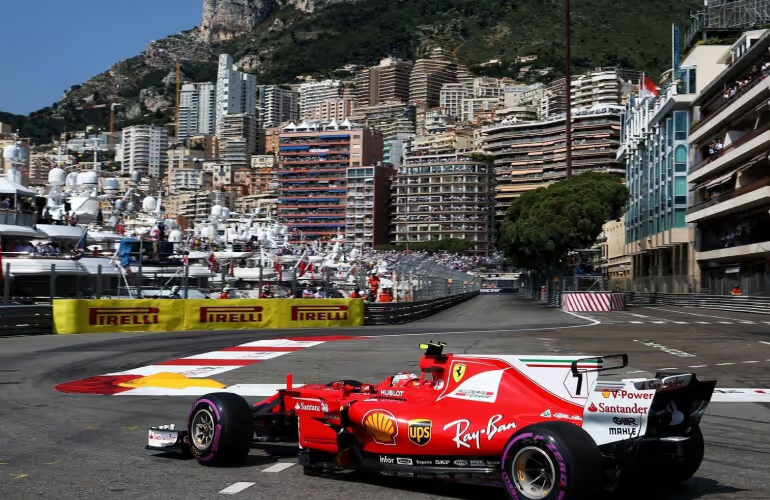
The most prestigious and glamourous automobile race in the world


Travel to the most popular locations on the calendar to experience an F1 race








Leave a Comment