


If you’ve ever watched an F1 race on Sunday and then looked at your hatchback on Monday thinking, “If only this had DRS…”, you’re not alone. Indian F1 fans often wonder whether those screaming, low-slung Formula 1 monsters can ever be driven legally on normal roads, maybe even past the neighbourhood tapri.
Sadly, the honest answer is a hard no: real F1 cars are not street legal, not in India, not in Europe, not in the US, nowhere.
An F1 car is a purpose-built race machine designed only to go as fast as possible on closed circuits, not to survive potholes, speed breakers, or RTO inspections. To be street legal, a vehicle has to comply with national road safety laws, equipment rules, and emissions norms—and F1 cars miss almost every single requirement.
In simple terms, there are two big problems: even if you somehow managed to drive one on the road, it would be almost undriveable in real traffic, and even if you could drive it, the law simply doesn’t allow it. So you’re blocked both by physics and by paperwork.
Every country has its own vehicle regulations, but the basics are broadly similar: you need lights, mirrors, registration plates, horn, indicators, basic crash safety, emissions compliance, and roadworthy brakes. An F1 car fails almost all of these.
Key missing or non-compliant items on a typical Formula 1 car:
In India, there’s an extra reality check: vehicle modification rules prohibit major structural changes and unapproved engine swaps, and you need RTO approval for anything that significantly alters structure, powertrain, or dimensions. That’s the total opposite of w+D8hat an F1 car is, which is radical in all three.
Even if regulations magically disappeared, driving an F1 car on public streets would still be a nightmare. These cars are optimised for smooth tracks, not your daily office commute over broken tarmac and heroic speed breakers.
Major engineering barriers: Insanely low ride height: F1 cars run with front ride height of only a few centimetres to maximise downforce. Typical Indian “scientifically designed” speed breakers are around 100 mm high—and in reality often even taller. That means an F1 car would beach itself on the very first speed bump outside your society gate.
Super-stiff suspension: The suspension is designed for smooth race circuits and huge downforce loads, not potholes, rumble strips, or concrete patches. On Indian roads, the car would skip, scrape, and potentially damage critical components within a few hundred metres.
Race-spec brakes: Carbon brakes in F1 work properly only when extremely hot, which they reach under repeated hard braking from very high speed. In stop-go traffic at low speeds, they may not bite properly, making the car unsafe.
Hyper-sensitive engine: F1 power units are built to run at sky-high revs and temperatures, with complex hybrid systems and fuel blends, not to idle peacefully in a traffic jam behind an auto-rickshaw. Running them at low speeds and constant idling can damage components or overheat systems.
Basically, the car expects Silverstone; it gets Outer Ring Road in peak hour.
Now add the Indian context. Ground clearance is already a big deal even for regular sedans and supercars thanks to tall speed breakers and rough patches. Car experts in India often suggest higher ground clearance to avoid underbody damage, and many owners already have to attack speed bumps diagonally in low-slung sports cars.
Some data points that show how bad it would be for an F1 car:
Where your friend’s supercar already struggles and scrapes, an F1 car simply doesn’t stand a chance.
Even if you somehow avoid scraping the floor and blowing up the engine, actually driving an F1 car on the road would be a very expensive form of torture.
Key practical issues:
Forget parallel parking at the mall—you’ll be lucky to clear the basement ramp without leaving half your front wing behind.
Technically, it is possible to modify a racing car to meet road-legal requirements in some countries—but by the time you’re done, it is barely an F1 car anymore. You would have to redesign major systems and add equipment that changes weight, aerodynamics, and handling.
Typical modifications needed:
In many jurisdictions, builders who turn race cars into road cars go through complex “individual approval” processes, crash tests, and inspections. The cost of engineering, testing, and legal compliance can easily exceed the value of the donor F1 car, running into millions of dollars or pounds.
Despite all the urban legends floating around on social media, there is no developed country where a standard, unmodified Formula 1 car can be registered as a normal road vehicle. Road authorities require minimum safety and equipment standards that these cars simply don’t meet.
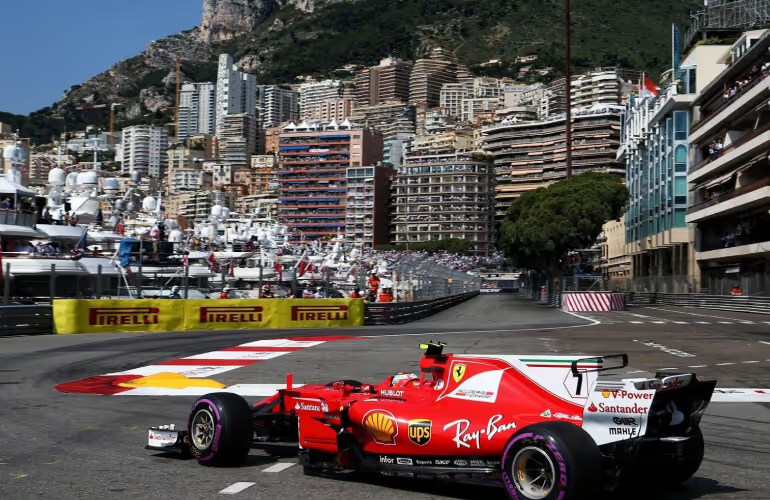
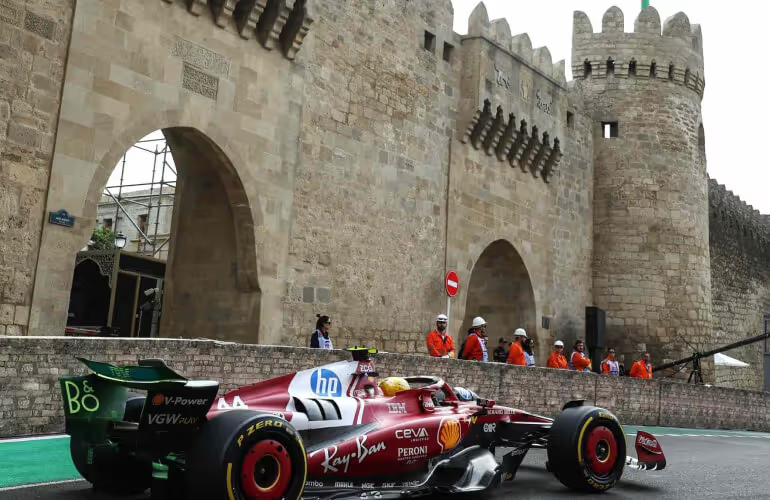
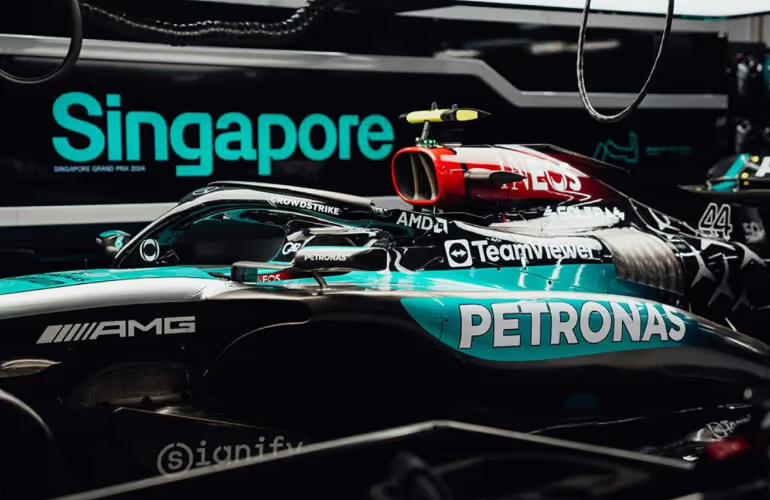
At best, cities temporarily close public roads and convert them into street circuits—like in Monaco, Singapore, Baku, or Las Vegas—where F1 cars can run on what are usually normal streets, but only under race conditions with barriers, marshals, and no public traffic. Those events are exceptions granted for organised races, not a free pass to drive F1 cars to office.
While you can’t register a real F1 car, you can buy cars that borrow heavily from F1 technology and are built from day one as road legal hypercars. These machines aim to bring “F1 for the road” with different philosophies.
Some famous examples:
These cars show what happens when engineers start with road legality as a requirement and then inject as much F1 DNA as the rules allow, rather than trying to tame an actual F1 chassis for the street.
Indian Reality: Supercars vs Roads, Not F1 vs Roads
India has an increasingly active supercar and hypercar scene, with owners in cities like Mumbai, Delhi, Bengaluru, and Hyderabad dealing daily with the “ground clearance vs speed breaker” boss battle. Even regular low-slung sports cars often need careful angles, lift systems, and extreme patience to cross some of the taller humps and broken sections.
Owners are advised to:
Avoid poorly maintained roads and unexpected speed breakers as far as possible.
Use ceramic coatings, PPF, and careful driving to protect expensive bodywork.
Sometimes even choose SUVs or higher-clearance vehicles as daily drivers and keep the supercar purely for selected routes.
If road-legal supercars already struggle, that gives a good reality check on why an actual F1 car is a total non-starter.
If budgets and dreams are big enough, you can buy a decommissioned F1 car from teams, private sellers, or auctions. Prices typically range from high six figures to several million in major currencies, depending on the car’s history, condition, and whether the original engine is still present and runnable.
However, these cars come with strings attached:
Think of it as buying a pet dragon—cool, but not ideal for a casual grocery run.
Even the wildest hypercars cannot fully match modern F1 performance, especially in corners and over race distance. But some get close enough that ordinary humans will run out of courage long before the car runs out of grip.
Examples of “closest to F1” road-legal performance cars include:
These cars provide some of the acceleration, braking, and responsiveness that F1 fans crave, while still meeting crash, lighting, and emissions rules.
Even if you never sit in an F1 car or a hypercar, you still benefit from F1 technology. Many advances developed in motorsport eventually make their way into everyday cars.
Some trickle-down examples include:
So while your car may not have a halo or DRS, some of the underlying engineering ideas do trace back to the paddock.
Yes, private collectors can buy decommissioned F1 cars, usually at very high prices, but they are limited to use on private property or race tracks and cannot be registered for normal road use.
Registration would be refused because the car lacks mandatory safety and equipment features like lights, mirrors, number plates, emissions compliance, and crash requirements.
No country with proper road regulations allows an unmodified F1 car to be registered and used like a normal road vehicle; actual F1 cars run on public roads only during authorised street races with roads closed to traffic.
The required engineering changes, certification, and testing could cost more than buying the original car, easily running into millions once you account for redesign, emissions work, and legal approvals.
Hypercars such as the Aston Martin Valkyrie, Mercedes AMG One, and Gordon Murray T.50 are among the closest road-legal machines to F1 in terms of performance philosophy and technology, although they still fall well short of an actual Formula 1 car on track.
Yes, many ideas from F1—from materials and aero to hybrid control strategies—are adapted and simplified for road use, always tuned for durability, comfort, and regulations rather than pure lap time.
The most prestigious and glamourous automobile race in the world


Travel to the most popular locations on the calendar to experience an F1 race








Leave a Comment