

If you’re an F1 fan in India wondering, “When exactly did Max Verstappen join Formula 1, and how did he become so dominant?” you’re in the right place.
Max didn’t just enter F1; he turned the sport upside down before he was even legally allowed to rent a car in most countries.
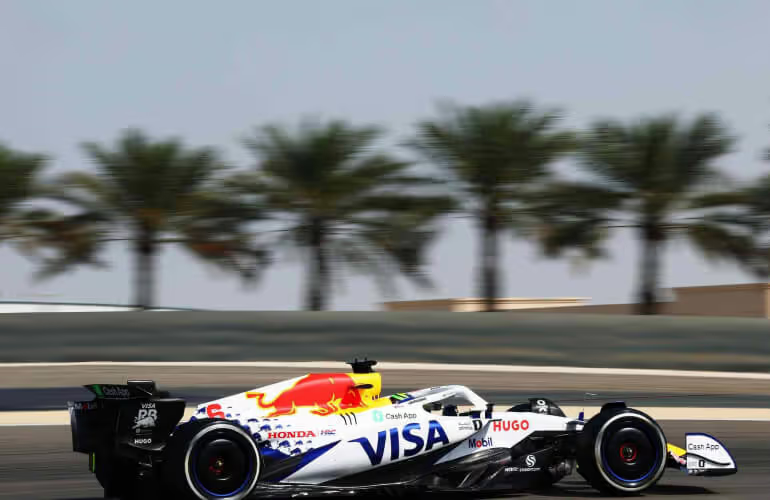
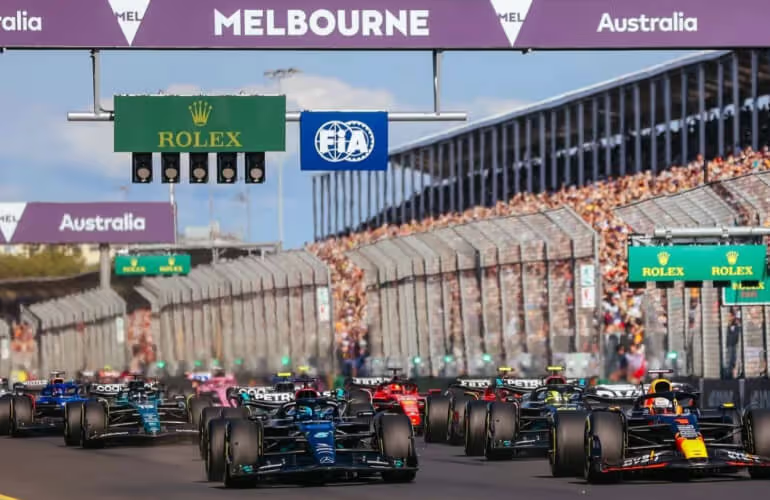
Max Verstappen made his official Formula 1 debut on 15 March 2015 at the Australian Grand Prix in Melbourne, driving for Scuderia Toro Rosso (now known as Visa Cash App RB). At just 17 years and 166 days old, he became the youngest driver ever to start a Formula One World Championship race, smashing the previous record by almost two years.
He qualified 12th and started 11th due to another driver’s non-start, and although his race ended with an engine failure, his calm and pace immediately impressed teams, media, and fans.
Karting Monster: The Early Years
Before Formula 1, Verstappen was already a serious name in European karting. He dominated multiple championships, including major European and world-level series, often beating older and more experienced rivals. These performances signalled to F1 teams that this wasn’t just a “good” young driver – this was a future world champion in the making.
Formula 3 and the Red Bull Call
In 2014, Verstappen moved into European Formula 3, where he took an eye-catching number of wins and bold overtakes that got everyone’s attention, especially Red Bull’s Helmut Marko, who heads their junior programme. Instead of forcing him through every traditional step like GP2/F2, Red Bull offered him a Toro Rosso race seat for 2015, making him one of the most aggressively promoted young drivers in modern F1 history.
Max’s father, Jos Verstappen, raced in Formula 1 in the 1990s and early 2000s, with stints at teams like Benetton.Jos used his experience to guide Max through karting, junior categories, and the politics of F1, helping him understand contracts, travel, media, and technical feedback from a very young age.
Of course, being Jos’s son opened doors, but staying inside those doors required ridiculous speed, discipline, and mental strength – qualities Max showed in abundance.
Traditionally, drivers prove themselves in GP2/F2 before even dreaming about a full-time F1 seat. Red Bull tore up that rulebook for Verstappen. Their philosophy was simple: if the data and on-track performance prove you’re fast and consistent enough, they won’t keep you waiting just to satisfy tradition. Telemetry and analysis from Verstappen’s junior career showed:
• Elite car control, especially in wet and changing grip conditions
• Consistent lap times on long runs
• A natural instinct for overtaking and race craft that resembled some of the sport’s greats
That was enough for them to fast-track him straight to Toro Rosso at 17.
In his 2015 rookie season, Verstappen quickly moved from “interesting young driver” to “serious future star.”
• He finished 12th in the drivers’ championship, a strong result for a midfield car.
• His best race result was fourth place, showing he could fight near the front when circumstances allowed.
Along the way, he pulled off overtakes that had commentators comparing him to legends like Ayrton Senna and Michael Schumacher (minus the age and the hairline).
Just four races into the 2016 season, Red Bull made a stunning decision: they promoted Max Verstappen to Red Bull Racing, swapping him with Daniil Kvyat ahead of the Spanish Grand Prix.
Many thought the move was risky; some said it was unfair to Kvyat. But Red Bull believed Verstappen’s talent ceiling was simply too high to be left in the junior team.
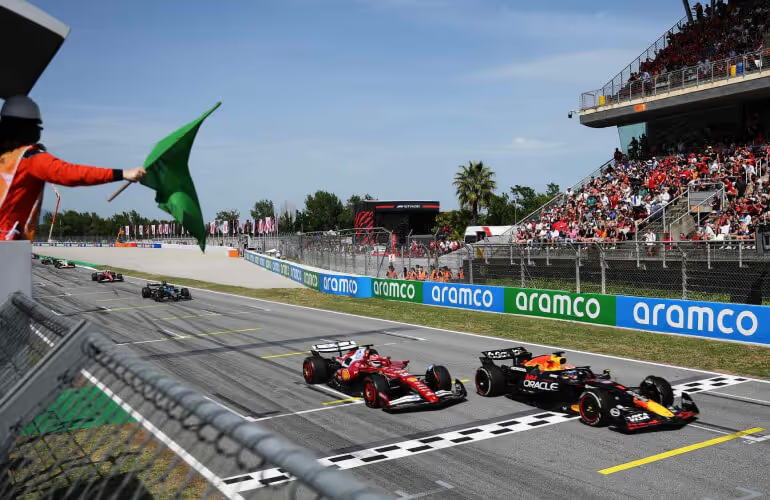
If the promotion was controversial, Verstappen’s answer came on the track. At the 2016 Spanish Grand Prix, his very first race for Red Bull, he won the race and became the youngest driver ever to win a Formula 1 Grand Prix, at 18 years and 228 days.
He also became the youngest driver to stand on a Formula 1 podium, breaking records previously held by Sebastian Vettel by more than two years.That day, he didn’t just win a race – he announced the start of a new F1 era.
Fast forward to 2021, and Verstappen finally had a car capable of taking the fight to Mercedes and Lewis Hamilton. The season turned into one of the most intense title battles F1 has ever seen, going all the way to the final race in Abu Dhabi.
After a dramatic and controversial finale, Verstappen took his first Formula 1 World Championship, becoming the 34th driver ever to win the title and ending Hamilton’s run of dominance.
Once the first title came, the floodgates opened.
• In 2022, Verstappen set a new record with 15 wins in a single season, more than any driver had ever managed before.
• In 2023, he extended his streak, including a record-breaking 10 consecutive Grand Prix victories in one stretch, and continued rewriting the stats pages.
By late 2024, Verstappen had secured four consecutive world championships (2021–2024), underlining his status as one of the greatest drivers of his generation.As of the 2025 season, he has over 70 race wins, more than 45 pole positions, and a stack of records that make him one of the most statistically dominant drivers in F1 history.
The surge of Indian F1 fans thanks to OTT streaming and social media has met the rise of Verstappen at exactly the right time.His no-nonsense attitude, direct answers, and focus on performance over PR resonate strongly with Indian audiences who respect hard work, competitiveness, and blunt honesty.
For many younger viewers discovering F1 via Netflix and YouTube, Verstappen is the face of modern Formula 1 – the driver who made the sport feel raw, intense, and real again.
Verstappen’s success as a teenager changed how teams think about age and experience.
His career encouraged outfits like Red Bull, Mercedes, Ferrari, and McLaren to invest more heavily in junior academies and to give young drivers earlier opportunities in F1 machinery. Drivers like George Russell, Lando Norris, and Oscar Piastri have all benefited from this new mindset of trusting young talent if the data and results back them up.
Max Verstappen joined Formula 1 in 2015, making his debut at the Australian Grand Prix in Melbourne on 15 March with Scuderia Toro Rosso.
He was 17 years and 166 days old, making him the youngest driver ever to start a World Championship Formula 1 race.
Verstappen won his first race at the 2016 Spanish Grand Prix in his very first outing for Red Bull Racing, becoming the youngest F1 race winner in history.
As of 2025, Verstappen has four Formula 1 World Championships, winning titles from 2021 through 2024.
Because it involved a mid-season swap with Daniil Kvyat, and Verstappen was still very young with limited F1 experience, some felt the move was too ruthless. However, his immediate win in Spain silenced most critics.
Beachfront city with nightlife, a beach, and an epic race


Travel to the most popular locations on the calendar to experience an F1 race





Leave a Comment