All You Ever Need to Know About F1

Latest stories about drivers, teams, strategies, circuits, car developments, and much more

Thank you! Your submission has been received!
Oops! Something went wrong while submitting the form.
Blog Image
January 19, 2026
3
min read
F1 Cars

If you’ve ever watched an F1 race on Sunday and then looked at your hatchback on Monday thinking, “If only this had DRS…”, you’re not alone. Indian F1 fans often wonder whether those screaming, low-slung Formula 1 monsters can ever be driven legally on normal roads, maybe even past the neighbourhood tapri.

Sadly, the honest answer is a hard no: real F1 cars are not street legal, not in India, not in Europe, not in the US, nowhere.

Why F1 Cars Are Not Street Legal Anywhere

An F1 car is a purpose-built race machine designed only to go as fast as possible on closed circuits, not to survive potholes, speed breakers, or RTO inspections. To be street legal, a vehicle has to comply with national road safety laws, equipment rules, and emissions norms—and F1 cars miss almost every single requirement.

In simple terms, there are two big problems: even if you somehow managed to drive one on the road, it would be almost undriveable in real traffic, and even if you could drive it, the law simply doesn’t allow it. So you’re blocked both by physics and by paperwork.

Legal Requirements F1 Cars Fail (Globally and in India)

Every country has its own vehicle regulations, but the basics are broadly similar: you need lights, mirrors, registration plates, horn, indicators, basic crash safety, emissions compliance, and roadworthy brakes. An F1 car fails almost all of these.

Key missing or non-compliant items on a typical Formula 1 car:

  • No headlights, tail-lights, brake lights, or turn indicators for night or low-visibility driving.
  • No horn, no proper external mirrors, and no mounting points or illumination for number plates.
  • No handbrake/parking brake as required in most road regulations.
  • No proper bumper structures or pedestrian-impact protection designed for road crashes.
  • Race-grade exhaust and engine mapping that massively exceed normal road noise and emissions limits.

In India, there’s an extra reality check: vehicle modification rules prohibit major structural changes and unapproved engine swaps, and you need RTO approval for anything that significantly alters structure, powertrain, or dimensions. That’s the total opposite of w+D8hat an F1 car is, which is radical in all three.

Engineering Reasons F1 Cars Hate Normal Roads

Even if regulations magically disappeared, driving an F1 car on public streets would still be a nightmare. These cars are optimised for smooth tracks, not your daily office commute over broken tarmac and heroic speed breakers.

Major engineering barriers: Insanely low ride height: F1 cars run with front ride height of only a few centimetres to maximise downforce. Typical Indian “scientifically designed” speed breakers are around 100 mm high—and in reality often even taller. That means an F1 car would beach itself on the very first speed bump outside your society gate.

Super-stiff suspension: The suspension is designed for smooth race circuits and huge downforce loads, not potholes, rumble strips, or concrete patches. On Indian roads, the car would skip, scrape, and potentially damage critical components within a few hundred metres.

Race-spec brakes: Carbon brakes in F1 work properly only when extremely hot, which they reach under repeated hard braking from very high speed. In stop-go traffic at low speeds, they may not bite properly, making the car unsafe.

Hyper-sensitive engine: F1 power units are built to run at sky-high revs and temperatures, with complex hybrid systems and fuel blends, not to idle peacefully in a traffic jam behind an auto-rickshaw. Running them at low speeds and constant idling can damage components or overheat systems.

Basically, the car expects Silverstone; it gets Outer Ring Road in peak hour.

Why Indian Roads Are Especially Hostile to F1 Cars

Now add the Indian context. Ground clearance is already a big deal even for regular sedans and supercars thanks to tall speed breakers and rough patches. Car experts in India often suggest higher ground clearance to avoid underbody damage, and many owners already have to attack speed bumps diagonally in low-slung sports cars.

Some data points that show how bad it would be for an F1 car:

  • Ideal speed breakers per Indian guidelines: about 100 mm high.
  • Real-life speed breakers: often 150–170 mm or worse.
  • F1 ride height: just a few tens of millimetres, far less than even low-slung road supercars.

Where your friend’s supercar already struggles and scrapes, an F1 car simply doesn’t stand a chance.

Comfort? What Comfort: Driving Position, Gearbox and Visibility

Even if you somehow avoid scraping the floor and blowing up the engine, actually driving an F1 car on the road would be a very expensive form of torture.

Key practical issues:

  • Driving position: Drivers sit in a tight carbon tub, almost lying down with knees higher than hips, wrapped in a seat moulded to their exact shape. Great for G forces, terrible for long drives or daily use.
  • Gearbox and clutch: Modern F1 cars use paddle shifters and ultra-aggressive clutches; low-speed manoeuvres like parking, crawling in traffic, or U turns are extremely difficult and easy to stall.
  • Visibility: The cockpit is low, the car is wide, and visibility is deliberately focused forward for track use, not for spotting bikers squeezing through gaps at signals.

Forget parallel parking at the mall—you’ll be lucky to clear the basement ramp without leaving half your front wing behind.

What It Would Take to Make an F1 Car Street Legal

Technically, it is possible to modify a racing car to meet road-legal requirements in some countries—but by the time you’re done, it is barely an F1 car anymore. You would have to redesign major systems and add equipment that changes weight, aerodynamics, and handling.

Typical modifications needed:

  • Full lighting package: headlights, tail-lights, brake lights, indicators, hazard lights with proper road certifications.
  • Mirrors, horn, and properly lit number plates front and rear.
  • A parking brake system, and possibly swapping or heavily modifying the brake hardware for road use.
  • Raised ride height and softer suspension to survive normal roads, speed breakers, and driveways.
  • Revised bodywork to protect pedestrians and to fit road-legal lighting and plates without shredding airflow.
  • Engine remap or replacement for emissions, noise, reliability, and drivability at low speeds.

In many jurisdictions, builders who turn race cars into road cars go through complex “individual approval” processes, crash tests, and inspections. The cost of engineering, testing, and legal compliance can easily exceed the value of the donor F1 car, running into millions of dollars or pounds.

Why No Country Lets You Register a Real F1 Car

Despite all the urban legends floating around on social media, there is no developed country where a standard, unmodified Formula 1 car can be registered as a normal road vehicle. Road authorities require minimum safety and equipment standards that these cars simply don’t meet.

At best, cities temporarily close public roads and convert them into street circuits—like in Monaco, Singapore, Baku, or Las Vegas—where F1 cars can run on what are usually normal streets, but only under race conditions with barriers, marshals, and no public traffic. Those events are exceptions granted for organised races, not a free pass to drive F1 cars to office.

Street-Legal F1 Inspired Hypercars You Can Actually Buy

While you can’t register a real F1 car, you can buy cars that borrow heavily from F1 technology and are built from day one as road legal hypercars. These machines aim to bring “F1 for the road” with different philosophies.

Some famous examples:

  • Aston Martin Valkyrie: Co-developed with Red Bull Advanced Technologies, it uses extreme aerodynamics and a screaming V12, delivering lateral G forces of over 3 g while still being road legal in certain markets.
  • Mercedes AMG One: Uses a power unit derived from Mercedes’ championship-winning hybrid F1 engine, adapted heavily so it can meet noise and emissions standards and survive normal use.
  • Gordon Murray T.50: Designed by the legendary engineer behind the McLaren F1, it focuses on lightweight construction and fan-based aero, giving a highly F1-like driving feel while being usable on public roads.

These cars show what happens when engineers start with road legality as a requirement and then inject as much F1 DNA as the rules allow, rather than trying to tame an actual F1 chassis for the street.

Indian Reality: Supercars vs Roads, Not F1 vs Roads

India has an increasingly active supercar and hypercar scene, with owners in cities like Mumbai, Delhi, Bengaluru, and Hyderabad dealing daily with the “ground clearance vs speed breaker” boss battle. Even regular low-slung sports cars often need careful angles, lift systems, and extreme patience to cross some of the taller humps and broken sections.

Owners are advised to:

Avoid poorly maintained roads and unexpected speed breakers as far as possible.

Use ceramic coatings, PPF, and careful driving to protect expensive bodywork.

Sometimes even choose SUVs or higher-clearance vehicles as daily drivers and keep the supercar purely for selected routes.

If road-legal supercars already struggle, that gives a good reality check on why an actual F1 car is a total non-starter.

Buying an F1 Car: What You Can Do

If budgets and dreams are big enough, you can buy a decommissioned F1 car from teams, private sellers, or auctions. Prices typically range from high six figures to several million in major currencies, depending on the car’s history, condition, and whether the original engine is still present and runnable.

However, these cars come with strings attached:

  • They are for private track use or display only, not for public roads.
  • They usually require specialist mechanics, transport, and maintenance.
  • Running costs are enormous, with rebuild intervals measured in hours of use, not kilometres.

Think of it as buying a pet dragon—cool, but not ideal for a casual grocery run.

Closest Road-Legal Cars to F1 Performance

Even the wildest hypercars cannot fully match modern F1 performance, especially in corners and over race distance. But some get close enough that ordinary humans will run out of courage long before the car runs out of grip.

Examples of “closest to F1” road-legal performance cars include:

  • Aston Martin Valkyrie
  • Mercedes AMG One
  • Gordon Murray T.50
  • Hardcore track-focused variants from brands like McLaren and Ferrari

These cars provide some of the acceleration, braking, and responsiveness that F1 fans crave, while still meeting crash, lighting, and emissions rules.

How F1 Tech Trickle-Down Reaches Your Road Car

Even if you never sit in an F1 car or a hypercar, you still benefit from F1 technology. Many advances developed in motorsport eventually make their way into everyday cars.

Some trickle-down examples include:

  • Advanced lightweight materials and composites.
  • Better tyre technology and understanding of grip and wear.
  • Sophisticated engine management, hybrid systems, and energy recovery concepts.
  • Improved aerodynamics that help both performance and efficiency.

So while your car may not have a halo or DRS, some of the underlying engineering ideas do trace back to the paddock.

FAQ: F1 Cars and Street Legality

Can you buy a decommissioned F1 car for personal use?

Yes, private collectors can buy decommissioned F1 cars, usually at very high prices, but they are limited to use on private property or race tracks and cannot be registered for normal road use.

What happens if someone tries to register an F1 car for road use?

Registration would be refused because the car lacks mandatory safety and equipment features like lights, mirrors, number plates, emissions compliance, and crash requirements.

Are there any countries where F1 cars are street legal?

No country with proper road regulations allows an unmodified F1 car to be registered and used like a normal road vehicle; actual F1 cars run on public roads only during authorised street races with roads closed to traffic.

How much would it cost to make an F1 car street legal?

The required engineering changes, certification, and testing could cost more than buying the original car, easily running into millions once you account for redesign, emissions work, and legal approvals.

What is the closest road-legal car to an F1 car?

Hypercars such as the Aston Martin Valkyrie, Mercedes AMG One, and Gordon Murray T.50 are among the closest road-legal machines to F1 in terms of performance philosophy and technology, although they still fall well short of an actual Formula 1 car on track.

Can F1 technology be used in normal road cars?

Yes, many ideas from F1—from materials and aero to hybrid control strategies—are adapted and simplified for road use, always tuned for durability, comfort, and regulations rather than pure lap time.

Are F1 Cars Street Legal?

Do you often wonder whether those screaming, low-slung F1 monsters can ever be driven legally on normal roads?

Blog Image
January 19, 2026
3
min read
Race Circuits

You've finally decided to experience the adrenaline rush of a live race weekend?

Brilliant! Whether you're planning to watch the British Grand Prix at Silverstone or the Italian GP at Monza – Temple of Speed, or experience that first night race buzz at Singapore’s street circuit, this guide has got you covered.

Let me walk you through everything you need to know to make your race weekend absolutely unforgettable; without the rookie mistakes.

Getting to Your Circuit: The Great F1 Adventure

Here's the thing: getting to the race circuit can be just as much of an adventure as watching the race itself. Most of the racing circuits are on the outskirts of the main city limits.

Let's break down your transport options:

Shuttle Buses are your best friend if you're traveling from nearby towns or railway stations. Most circuits arrange free or budget-friendly shuttle services, and the best part? You don't usually need to book in advance. Just show up and hop on!

Public Transport can work if you've picked a hotel close to metro stations or train stops. However, fair warning: walkability varies, so do your homework beforehand.

Driving offers flexibility but comes with a catch. While most circuits offer parking, imagine thousands of other fans trying to exit simultaneously after the final race. Traffic jams are real, and they're not fun.

Pro Tip: Hop on to the coach buses provided by us at race locations. Leave early. Very early. Like, "skip your morning chai" early.

Taxis and Cabs are convenient, but again, post-race traffic can turn a 30-minute journey into a two-hour ordeal. Pro move? Book your return ride in advance, or better yet, stay for a bit after the crowd thins out.

But these work out to be really expensive.

The Ultimate Flex: Helicopter Rides If you're feeling James Bond vibes and have the budget, yes, some circuits do offer helicopter access. It's not exactly budget-friendly, but it's definitely Instagram-worthy!

The Real Talk: Whatever transport option you choose, plan to stay at the circuit for at least 30-45 minutes after the race concludes. Seriously. Use this time to grab some food, chat with other fans, or just soak in the post-race energy. Your commute will thank you.

Weather: The Unpredictable Beast

Let's be honest—Weather at most of the racing circuits is as unpredictable. You could be planning for clear skies and then BOOM, the monsoon decides to crash the party.

For those scorching summer races: Bring a hat (non-negotiable), quality sunglasses, and sunscreen with at least SPF 50. Seriously, sitting in a grandstand for hours without protection is a recipe for painful burns and regret. Dehydration is also a real risk, so invest in a refillable water bottle. Most circuits have water stations, but they get crowded.

When rain's in the forecast: Here's the thing—rain can actually create the most thrilling on-track action. But for you in the stands? It's less thrilling and more "soggy." Waterproof jackets or ponchos are essential.

You can bring umbrellas, but check the circuit's policy first; many grandstands restrict them because, well, nobody wants your umbrella poking them in the face.

The Pro Move: Even if the forecast looks crystal clear, toss a light rain jacket in your bag

What to Wear: Comfort is King

Here's what most first-timers get wrong: they show up in their best outfit and then spend the entire day miserable. Wrong approach!

You'll likely be doing more walking than you expect—navigating the circuit grounds, finding your grandstand, hitting the loo, grabbing snacks. Comfortable shoes are non-negotiable. Leave the fancy heels or formal shoes at home unless you enjoy blisters as a race souvenir.

Temperature swings are real: If you're staying into the late afternoon or evening, temperatures can drop noticeably. Grandstands in higher rows get windy too, so a light jacket or sweater is smart packing. Think layers—you can always remove them if you get warm.

Dress code wisdom: Most spectator areas have zero dress codes. Wear whatever makes you comfortable. However, if you're lucky enough to snag hospitality or corporate box access, those usually come with smart-casual expectations. Check your ticket details beforehand.

Food and Drink: Fuel for the Race

Let's address the elephant in the room: circuit food is overpriced. We all know it. But you'll be hungry, so let's make smart choices.

Most circuits offer standard fare from mobile catering vans. Quality varies, but you know what they say about free markets and all that. Budget accordingly; these places are not cheap.

The Good News: Most circuits are cool with you bringing your own snacks and drinks. Pack some homemade burgers, fruits, sandwiches, or energy bars. Just avoid bringing glass bottles of alcohol (many circuits have strict policies on this) and plastic bottles that you can't dispose of responsibly. If you do want to bring alcohol, stick to cans or packable containers and consume responsibly.

: Eat a proper meal before you arrive at the circuit. You'll save money and avoid standing in massive food queues during crucial race moments.

Photography and Video: Know the Rules

Smartphones and standard cameras? Absolutely fine. Take all the selfies and race footage you want for personal memories and your Instagram stories.

However, don't bring professional-grade equipment with giant telephoto lenses—yes, they get incredible shots, but they block other people's views and can raise questions about intent.

Many circuits have strict policies against commercial photography and video. If you're trying to be the next motorsport cinematographer, that's a conversation to have with circuit management beforehand, not when you're entering the gates.

Bottom Line: Use your phone camera freely, but leave the 70mm telephoto lens at home.

Seating Strategy: Location, Location, Location

If you've got a reserved grandstand ticket: Congratulations! Your seat is guaranteed. Just show up on time and enjoy the view.

For general admission tickets: This is where strategy comes in. Many fans bring portable folding stools or camping chairs (check the circuit's specific policy first—most are fine with portable seating).

Here's the insider's secret: if you're at the circuit for practice sessions or qualifying on earlier days, scout out the best spot for race day. Visit different corners, check sight lines, and find your sweet spot.

The Race Day Reality: Things get absolutely packed during the main race. The best viewing spots fill up quick, so arrive early—and I mean properly early, not "5 minutes before the race" early. Get there in the morning, set up your camp, grab breakfast, and settle in for the day.

Bring These Essentials (Trust Me)

  • Portable phone charger: You'll be taking videos, photos, and using Google Maps. Your battery will hate you.
  • Hand sanitizer and wet wipes: Because circuit toilets are... well, circuit toilets.
  • Sunscreen: Even if you think you won't need it. You will.
  • A good book or download some movies: There are gaps between races, and trust me, you'll want to stay occupied.
  • Cash and cards: Not all circuit vendors accept digital payments, though this is improving.
  • Plastic bag: For trash and wet items if it rains.

Etiquette: Be the Fan Everyone Wants Around

This is simple but important: respect fellow spectators. Don't block views with your camera, don't be that person screaming obscenities, and if someone asks you to move your chair, just move it. The racing community is a tight-knit group, and reputation matters.

Cheer for your favorite drivers, absolutely. But remember: folks next to you might support different teams, and that's okay. It's all part of the fun.

Your Race Weekend Checklist

✓ Check weather forecast the day before

✓ Plan your transport and pre-book if necessary

✓ Pack sunscreen, hat, and comfortable shoes

✓ Bring layers (jacket/sweater for temperature drops)

✓ Pack snacks and refillable water bottle

✓ Charge your phone and bring a portable charger

✓ Scout your viewing spot early (for GA tickets)

✓ Check circuit-specific policies on alcohol, seating, and photography

✓ Plan to stay 30-45 minutes after the race for traffic to clear

✓ Most importantly: Enjoy yourself and embrace the chaos!

Your Complete Guide to Racing Circuit Etiquette

Everything you need to know to make your race weekend absolutely unforgettable; without the rookie mistakes.

Blog Image
January 19, 2026
3
min read
Latest News

It's a Sunday evening in Mumbai, and sports bars that were once exclusively reserved for cricket highlights are suddenly buzzing with something different. The sound of screaming V6 hybrid engines. Carbon-fiber machines flying at 300 km/h. Fans with the same intensity they reserve for India vs Pakistan matches are now glued to their screens watching little red cars go around in circles.

Yes, Formula 1 has genuinely arrived in India.

And honestly? Nobody saw this coming. In a country where cricket is practically a religion, Formula 1, traditionally seen as a sport for European elites and billionaires has somehow become the coolest thing to talk about at office coffee breaks and college campuses. It's like watching a Ferrari suddenly decide to take the slower lane on the Mumbai-Pune highway. Unexpected, but absolutely thrilling.

The F1 Takeover In Numbers

Let's talk facts, because the growth numbers for Formula 1 in India are more shocking than a Vettel overtake.

When Liberty Media took over Formula 1 in 2017, they had a radical idea: strip away the snobbery. No more treating the sport like it's exclusive to people who can pronounce "Bahrain" correctly or understand what a "downforce" is. Instead, they went all-in on digital storytelling, compelling narratives, and making the sport human.

The strategy? Absolutely genius. The results? Mind-blowing.

  • Global F1 Revenue (2024): $3.4 billion
  • Worldwide TV Viewers: 1.6 billion
  • Global F1 Fanbase: 826.5 million

But here's where it gets interesting for India specifically. From just 31 million fans in 2020 we're talking about potentially 78 million F1 fans in India right now. That's not just a sports trend, that's a cultural shift happening in real-time.

And those 15 million YouTube views from India in 2024? That's just the beginning.

The Indian Grand Prix That Could Have Been

Let's rewind to 2011. India got a taste of Formula 1 fever when the Buddh International Circuit hosted the Indian Grand Prix. The inaugural race? A massive 95,000 fans showed up. 95,000. In a country where people still had to look up what F1 even was!

Then Sebastian Vettel did what Sebastian Vettel does best—he won. That victory planted seeds. Important seeds. The kind that would eventually grow into a forest of F1 fans across India.

But here's the thing: it didn't last. Financial realities and regulatory headwinds killed the Indian Grand Prix after just three years (2011-2013). The circuit closed. F1 left India. Case closed.

Or so everyone thought.

Netflix's "Drive to Survive"

While the Indian Grand Prix was fading into history, something more powerful was happening: Netflix.

"Drive to Survive" didn't just show Formula 1. It reinvented it.

Instead of focusing on tire pressures and DRS systems (honestly, who cares?), Netflix focused on what actually matters—the humans. The rivalries. The drama. The politics. The triumphs and heartbreaks. It turned a technical sport into a psychological thriller about high-stakes competition and personal ambition.

The demand numbers in India? 8.7 times higher than average TV series. Think about that. In a country obsessed with everything from cricket documentaries to true crime shows, Formula 1 outperforms them all.

Suddenly, drivers became genuine celebrities—not just racing legends, but cultural icons:

  • Lewis Hamilton transcended racing to become a fashion icon and activist
  • Max Verstappen embodied sporting excellence and dominance
  • Ferrari's Charles Leclerc represented a team steeped in mystique and heritage
  • Lando Norris went viral on social media with Gen-Z audiences

These guys aren't just drivers anymore.

Who's Actually Watching F1 in India?

Here's where it gets interesting for brands and marketers: F1's Indian audience is exactly the demographic everyone wants to reach.

We're talking about:

  • Urban professionals with disposable income
  • Students and young adults with a global outlook
  • Digital natives who spend more time on social media than watching traditional TV
  • Premium consumers who actually have money to spend on luxury goods

These are the people who wear premium watches, drive high-end cars, and actually care about cutting-edge technology. Traditional brands have always struggled to reach this audience. But F1? It attracts them like a pit crew to a car that needs servicing.

The demographic shift is real. F1 isn't just growing—it's growing among the right people from a marketing perspective.

The Elephant (or Rather, the Rupee) in the Room

Let's be honest: Formula 1 still carries an air of exclusivity that would make even premium airlines jealous.

During the Indian Grand Prix years, tickets ranged from Rs 30,000 to Rs 1,00,000—a significant barrier for middle-class fans. For comparison, the Singapore Grand Prix starts at Rs 40,000, while European races? Even pricier.

The sport's elite reputation hasn't completely disappeared. The paddock still smells of privilege. The VIP sections still feel untouchable to regular fans. This exclusivity has been both F1's allure and its biggest challenge in India.

But here's the thing: digital access has changed the game entirely.

You don't need Rs 50,000 to enjoy F1 anymore. You just need a smartphone and internet connection. That democratization of access is absolutely revolutionary, especially in India where smartphone penetration has exploded.

Why Brands Are Going Crazy for F1

F1's audience alignment creates organic marketing opportunities that don't exist anywhere else in sports. Here's why brands are absolutely obsessed with F1 in India:

Luxury and Automotive Brands

High-end timepieces, fashion houses, and performance vehicles find a natural home in F1. The sport perfectly blends technical excellence with glamour—basically, every luxury brand's dream audience.

Technology Companies

AWS, Google, and Oracle use F1 as a platform to showcase innovations in AI, cloud computing, and data analytics. When you're watching cars that run on millions of data points, it's easy to talk about cutting-edge tech.

Financial Services

Fintech platforms and investment apps target an audience already comfortable with complex financial products. F1 fans are sophisticated thinkers—they get it.

Lifestyle Brands

Monster Energy, Heineken, and KitKat leverage F1's global excitement and sheer coolness factor.

The Unconventional Players

Red Bull's 2023 demonstration run in Mumbai attracted 20,000 spectators—not by sponsoring a team, but by creating an immersive experience. That's next-level marketing.

Today, the smartest brands aren't just slapping logos on cars. They're creating localized content, digital campaigns, and exclusive events that actually resonate with Indian audiences.

Cricket Still Reigns Supreme (For Now)

Let's not pretend everything is smooth sailing. F1 faces some pretty serious obstacles in India:

Cricket's cultural dominance is absolutely real. For most Indians, cricket isn't just a sport—it's woven into the national identity. F1 isn't competing directly with cricket; it's more like fighting for attention in an already crowded sporting calendar.

Financial barriers persist. Between premium subscriptions, team merchandise, and the astronomical cost of attending races, F1 fandom still requires commitment. Not everyone can drop Rs 5,000 on a McLaren team kit or subscribe to F1 TV Pro.

Geographic concentration is another issue. Most F1 fans are clustered in metro cities. Tier II and Tier III cities remain largely untapped.

The lack of Indian representation at the top level is a problem. When there's no Indian driver in F1, the emotional connection weakens significantly.

But here's the silver lining: things are changing.

Jehan Daruvala and India's Rising Racing Talent

Enter Jehan Daruvala—a name that could change everything.

A Red Bull Junior Program graduate with multiple Formula 2 podiums and reserve driver experience in both Formula E and F1, Daruvala represents something massive for India: homegrown talent. His journey has ignited national interest in motorsport and inspired a new generation of Indian racers to dream bigger.

When Indians see one of their own on the global stage, competing alongside international drivers, something shifts. It's personal. It's relatable. It's inspiring.

Opportunities are beginning to emerge:

  • Regional-language broadcasting could reach Hindi, Tamil, and Telugu-speaking audiences
  • Fan festivals across Tier I and Tier II cities could bring F1 experiences outside Mumbai and Delhi
  • Grassroots karting investments could create a pipeline of Indian talent

The infrastructure for F1's growth in India is there. It just needs the right push.

From Digital Screens to Cultural Icon

Here's the thing people often miss: technology is the real hero of F1's India story.

A decade ago, if you were an Indian F1 fan, your options were limited. Maybe a premium cable subscription (if you could afford it). Maybe catching highlights on YouTube days later. International races? Forget about it unless you were traveling or had connections.

Today? You literally have access to everything:

  • Live streaming on multiple platforms
  • Highlights and analysis available within minutes
  • Social media clips featuring every dramatic moment
  • Driver interviews and behind-the-scenes content at your fingertips

An 18-year-old from Bangalore can follow every session, every race, every piece of drama from their bedroom. That wasn't possible five years ago.

This technology boom has accomplished something that seemed impossible a decade ago: it transformed an elite European motorsport into must-watch entertainment for millions of Indians across socioeconomic boundaries.

F1 Takes Over India's Sports Bars (and Hearts)

It's a Sunday evening, and sports bars that were once exclusively reserved for cricket highlights are suddenly buzzing with something different

Blog Image
January 8, 2026
3
min read
Latest News

You want to understand Formula 1, but the sport feels more complicated than your tax returns? Don't worry—I'll break down the world's most glamorous automotive chaos into digestible pieces. Whether you're catching the latest Grand Prix on your commute or trying to impress someone at a dinner party, this guide will make you sound like an absolute pro.

And yes, India has a spicy history with F1. More on that later!

What Exactly IS Formula 1? (And No, It's Not Your Mom's Racing Series)

Formula 1, or F1, is basically the Olympics of motorsport—except the athletes sit down, the stadium travels to 24 different countries, and a pit stop that takes two seconds can change your entire life. It's the highest level of global motorsport, blending cutting-edge engineering, superhuman fitness, and enough drama to rival your favorite Netflix series.

Think of it as a fast, high-stakes chess game played on tarmac at speeds that would make your highway speed governor weep. F1 uses open-wheel, single-seat cars approved by the Fédération Internationale de l'Automobile (FIA)—basically, the international referee of all things four-wheeled and absurdly fast.

The "formula" isn't some secret sauce locked in a vault. It's simply a clear set of rules that every team must follow. These rules keep racing fair (sort of) while pushing teams to innovate within strict limits, turning engineering creativity into a competitive sport.

Is F1 a Sport or Just Expensive Chaos? (Spoiler: Both)

F1 is absolutely a sport—and a massively respected one at that. Drivers aren't just steers incredibly fast cars; they're elite athletes in peak physical condition. We're talking about handling gravitational forces (G-forces) that would make a fighter jet pilot nod in respect, all while sitting in a cockpit that feels like a microwave set to "volcanic."

F1 drivers undergo rigorous training programs that rival Olympic athletes. They have to:

  • Endure lateral forces of up to 5G while turning (your neck feels like it's made of lead)
  • Work in cockpit temperatures that can exceed 50°C (hotter than a Delhi summer, minus the ceiling fan)
  • Maintain razor-sharp focus for 1.5 to 2 hours straight
  • Make split-second decisions worth millions of rupees

Plus, F1 is a team effort, not just individual heroics. Each team, called a "constructor," invests billions in research and development. They employ engineers, strategists, mechanics, and scientists working together like a finely-tuned (pun intended) machine to eke out tenths of a second.

What's a Grand Prix? (Hint: It's Not Your Grandpa's Race)

An F1 race is called a Grand Prix, French for "Grand Prize"—because the French basically invented racing and decided to give it a fancy name. The term dates back to 1906 (the French Grand Prix at Le Mans), carrying with it decades of prestige and tradition.

Each Grand Prix stands on its own, but also contributes to the season's championship battle—kind of like how each episode of your favorite series matters, but it's the overall season arc that really counts.

When Did Formula 1 Start? (The Indian Connection)

The FIA Formula One World Championship officially kicked off on May 13, 1950, at Silverstone in Britain. The first winner? Italy's Giuseppe Farina, beating his teammate Juan Manuel Fangio, who would go on to become an absolute legend.

But here's where it gets interesting for Indian fans: the rules for F1 were set in 1946 and became official in 1947—years before the championship even began. The sport grew out of the European Grand Prix scene of the 1920s and 1930s, featuring wild open-cockpit cars and endurance driving.

India's Love (and Heartbreak) Affair with Formula 1

If there's one thing that makes Indian F1 fans emotional, it's the story of the Indian Grand Prix.

The Dream: The Buddh International Circuit (2011-2013)

India finally got its Grand Prix in 2011 at the Buddh International Circuit in Greater Noida, about 40 km from Delhi. The circuit was designed by German architect Hermann Tilke and was nothing short of magnificent. It had fast, flowing corners, beautiful elevation changes, and the potential to be a world-class venue.

And oh, did F1 arrive in style! The inaugural race drew 100,000+ passionate Indian fans. The circuit had everything—grandstands, hospitality suites, and that undeniable energy you only get when a global sport finally comes home.

Here's the catch: Sebastian Vettel won all three editions of the Indian Grand Prix (2011, 2012, 2013), making Red Bull absolutely unstoppable. While Vettel celebrated his hattrick, the real story unfolding behind the scenes was turning into a bureaucratic nightmare.

The Tragedy: Why India Lost Its Grand Prix

This is where it gets grimly interesting. The Uttar Pradesh government classified Formula 1 as "entertainment rather than sport," which excluded it from tax exemptions. This single sentence cost India its F1 race.

The circuit was technically in Uttar Pradesh (near Greater Noida), but was branded as "New Delhi." The state government levied entertainment taxes on the event, and the dispute between Jaypee Sports International (the race organizer) and the Uttar Pradesh government led to the race being cancelled.

What followed was a sad carousel:

  • 2014: F1 skipped India
  • 2015: Promised return delayed to 2016
  • 2016: Never happened
  • 2026: Still waiting

The Buddh International Circuit still stands today, a beautiful monument to what could have been. Once awarded Motorsport Facility of the Year in 2011, the circuit remains structurally sound but is far from its former glory.

The Silver Lining: India's Recent Motorsport Resurgence

While F1 abandoned India, the sport didn't entirely forget us:

  • 2023 Hyderabad E-Prix: Hyderabad hosted the inaugural Formula E race on the Hyderabad Street Circuit, which winds through the streets of NTR Gardens along Hussain Sagar Lake. This was India's return to world-championship motorsport after a decade.
  • 2023 MotoGP: The Buddh International Circuit got a second life, hosting the inaugural Indian Motorcycle Grand Prix.
  • Current Hope: Discussions are ongoing about potentially bringing F1 back to India, though nothing is confirmed yet.

How Many F1 Drivers Are There? (And How Can Indians Get in?)

A standard F1 season has exactly 20 drivers, because there are 10 teams and each team runs two cars. These aren't weekend warriors—they're the crème de la crème of motorsport, vetted through countless junior championships and earning an FIA Super Licence (the pinnacle of racing credentials).

India's F1 Drivers: A Tale of Talent vs. Timing

India has produced some remarkable F1 talent, though the grid has been barren of Indian drivers for over a decade.

Narain Karthikeyan (2005-2012) Narain Karthikeyan became India's first Formula One driver when he debuted with Jordan in 2005. Born in Coimbatore, Tamil Nadu, he was an incredibly talented driver who scored points in only his third race at the chaotic 2005 United States Grand Prix (where most teams didn't even show up due to a tire safety dispute).

Karthikeyan later drove for Williams and returned to F1 with HRT in 2011, racing in front of his home crowd at the Indian Grand Prix. Unfortunately, he never had a competitive car in his F1 years. He was awarded the Padma Shri, India's fourth highest civilian honour, in 2010.

Karun Chandhok (2010-2011) Karun Chandhok became India's second F1 driver when he debuted with HRT in 2010, following Karthikeyan by five years. A Chennai native with excellent junior series credentials, Chandhok showed promise but struggled with underpowered machinery.

The tragic timing? He was let go by Team Lotus after the Japanese Grand Prix, meaning he couldn't race at the inaugural Indian Grand Prix three weeks later in India. Talk about Murphy's Law.

Both drivers never scored points or achieved a podium in F1, but they paved the way for future generations and brought Indian motorsport to global attention.

Kush Maini: India's Latest Hope (2025) Fast forward to 2025: Kush Maini, a 24-year-old from Bengaluru, was announced as Alpine's Test and Reserve Driver for the 2025 Formula 1 season, becoming the first Indian to hold such a position in over a decade. While he's not yet a full-time driver, Maini's role is crucial—he gets to drive F1 cars in testing, develop car setups, and potentially race if needed. It's a modern pathway to F1 that his predecessors didn't have.

The 11 F1 Teams: Meet the Gladiators

In 2026, these 11 teams will battle for supremacy:

  1. McLaren Formula 1 - The reigning powerhouses
  2. Oracle Red Bull Racing - Multiple time champions
  3. Scuderia Ferrari HP - The legendary Italian team
  4. Mercedes-AMG PETRONAS - The consistent performer
  5. MoneyGram Haas F1 - The American underdog
  6. Visa Cash App Racing Bulls - The junior Red Bull team
  7. Aston Martin Aramco Formula One - The glamorous team
  8. Stake F1 Team Kick Sauber - Set to become Audi's works team in 2026
  9. BWT Alpine Formula One - The French manufacturer
  10. Atlassian Williams Racing - Rebuilding and ambitious

Most teams are based in "Motorsport Valley" around Oxfordshire, England. Ferrari is the notable exception, building everything in Maranello, Italy—because tradition matters when you're Ferrari.

F1 Cars: Engineering Marvels That Cost Millions

Modern F1 cars are absolutely insane pieces of technology. They're custom-built, open-wheel, single-seat machines designed for one purpose: making humans question the laws of physics.

The Numbers That Matter:

  • Weight: Minimum 800 kg (including the driver, excluding fuel)
  • Engine: Turbocharged 1.6-litre V6 hybrid power units
  • Top Speed: 350+ km/h on long straights (Juan Pablo Montoya hit 372.6 km/h in 2005!)
  • Acceleration: 0-100 km/h in about 2.6 seconds
  • G-Forces: Up to 5G in corners, thanks to downforce

The Technology Behind the Madness:

  • Carbon fibre chassis: Insanely light yet rigid
  • Aerodynamics: Front and rear wings plus ground effect tunnels create downforce equivalent to 2.5x the car's weight
  • Hybrid Power: Electric motors recover energy from braking, making F1 surprisingly eco-conscious
  • Smart Brakes: Carbon disc brakes with thousands of cooling holes
  • 18-inch Wheels: Upgraded from 13 inches in 2022

How F1 Racing Works: The Grand Prix Weekend

An F1 weekend is a carefully choreographed spectacle running over three days (Friday to Sunday).

Friday: Practice Makes Perfect Two free practice sessions (FP1 and FP2) let teams dial in their cars and test new parts. Mechanics work furiously, data scientists analyze telemetry, and drivers get familiar with the track. Some weekends feature young or reserve drivers for extra running.

Saturday: Qualifying & Sprint Races Qualifying is a three-part knockout session:

  • Q1: All 22 cars battle; slowest 6 are eliminated
  • Q2: 15 cars race; slowest 6 are eliminated
  • Q3: Top 10 drivers fight for pole position

Since 2021, some races include Sprint races—short 100 km races that award points and add extra drama.

Sunday: The Main Event The Grand Prix race is the culmination of all the preparation. Drivers cover approximately 305 km (190 miles) in 1.5-2 hours, making strategic pit stops for tire changes (usually 2-3 stops). Modern pit crews can change all four tires in under two seconds. Yes, under TWO seconds.

F1 Points and Championships: The Scoreboard

The top 10 finishers score points each race:

  • 1st place: 25 points
  • 2nd place: 18 points
  • 3rd place: 15 points
  • And so on down to 10th: 1 point

For sprint races, only the top 8 score.

At season's end, two championships are awarded:

  1. Drivers' Championship: The driver with the most points wins
  2. Constructors' Championship: The team with the most combined points from both drivers wins

The Constructors' Championship is huge—it brings prestige, prize money, and bragging rights.

Global F1 Circuits: From Singapore to Saudi Arabia

F1 travels to incredible locations worldwide. In 2025, there are 24 races planned, showcasing the sport's global reach.

Iconic Tracks:

  • Silverstone (British GP): The birthplace of racing
  • Monza (Italian GP): A temple of speed
  • Monaco Grand Prix: Tight, prestigious, and insanely difficult (since 1929!)
  • Circuit of the Americas (Austin): A modern masterpiece
  • Suzuka (Japan): One of the most technically challenging tracks
  • Marina Bay (Singapore): A night race on city streets
  • Las Vegas Strip Circuit: Joined the calendar in 2023

The FIA maintains contracts with many venues stretching decades into the future, keeping F1 fresh and globally expansive.

F1 vs. Other Racing Series: What Sets It Apart

F1 vs. NASCAR:

  • F1 cars are open-wheel with advanced aerodynamics; NASCAR uses closed, stock-bodied cars
  • F1 races on road courses with elevation changes; NASCAR dominates ovals
  • F1 focuses on precision and aero grip; NASCAR emphasizes pack racing and drafting

F1 vs. IndyCar:

  • IndyCar cars are also open-wheel, but teams buy chassis from limited manufacturers (F1 teams build their own since 1981)
  • IndyCar mixes ovals, road courses, and street circuits
  • F1 is the global pinnacle; IndyCar is primarily North American

F1 vs. Formula E:

  • Formula E is all-electric; F1 uses hybrid combustion engines
  • Formula E races on temporary street circuits in major cities; F1 uses permanent and street tracks
  • Both are open-wheel, but F1 is for traditional racing fans; Formula E is for eco-conscious tech enthusiasts

Why Should Indian Fans Care About F1?

Let's be honest: F1 has treated India like a love interest who ghosted after three dates. But there are compelling reasons to stay invested:

  1. 1National Pride: Indian drivers and engineers are making waves. Kush Maini's appointment at Alpine is a big deal.
  2. Engineering Fascination: F1 showcases the cutting edge of automotive technology, something India's booming engineering sector relates to deeply.
  3. Global Entertainment: F1 is accessible on multiple platforms, with race timings often convenient for Indian viewers (European and Middle East races fall during India-friendly hours).
  4. The Hope Factor: The Buddh International Circuit still exists, and there's real talk about F1 returning to India post-2026.
  5. Mahindra Racing: India's own Mahindra team competes in Formula E, bringing electric racing home.
Formula 1 For Dummies For Indian F1 Fans

You want to understand F1, but the sport feels more complicated than your tax returns?

Blog Image
January 6, 2026
3
min read
Latest News

So you've finally decided to witness Formula 1 live instead of shouting at your TV during Sunday evening races.

Whether you're a die-hard Lewis Hamilton fan or just someone who thinks fast cars look cool, attending your first F1 Grand Prix is about to become the most expensive yet absolutely worth-it decision you'll make in 2026.

Let's break down everything you need to know about buying tickets, booking flights, finding accommodation, and actually surviving the trackside experience without melting into your seat (literally – it gets hot).

Should You Book Your F1 Trip in Advance? Short Answer: YES, Yesterday Would've Been Better

Thanks to Netflix's Drive to Survive turning F1 into mainstream entertainment (and making us all secretly want to be race engineers), tickets are disappearing faster than your last samosa at a family gathering.

Here's the hard truth: If you wait around thinking you'll "figure it out later," you'll end up:

  • Paying 3x the original price on black market websites
  • Booking a hotel in a location that requires a 2-hour commute to the circuit
  • Watching the race from the standing area behind a very tall man named Klaus

More than half of the 2026 F1 calendar races already have tickets on sale. The new technical regulations introduced for 2026 have made this season particularly exciting, so don't procrastinate. Seriously. Your bank account will thank you (well, it won't, but it will hurt less).

Which F1 Race Should You Attend?

Choosing your first F1 race is like selecting your first biryani – location matters, and you want to get it right.

The smart play: Attend a race in India, a nearby country, or somewhere you've been wanting to visit anyway. Why? Because combining a holiday with a race weekend is basically genius-level travel planning.

Your 2026 options include:

European Classics – Historic circuits in stunning locations like Austria and Belgium where you can pretend you're in a film. Pack your camera and your best Instagram captions.

City Track Madness – Melbourne, Montreal, Bakuand Mexico City circuits that go right through the city. These races have that "Formula 1 has taken over our streets" energy that's absolutely electric.

Night Race Spectacles – Singapore and Las Vegas host races under the lights. Singapore is sticky and chaotic; Las Vegas is glamorous and expensive. Choose your chaos accordingly.

Bonus Content – Six races in 2026 feature F1 Sprint weekends, which means even more racing and even less sleep.

Pro Tip: Research beyond just the race. Some circuits have world-class concerts, stunning nearby attractions, or incredible food scenes. Make it a trip, not just a race.

Organized Tour vs. DIY

Going with an Organized Tour?

  • Everything is handled for you (flights, hotels, transfers, even breakfast sometimes)
  • You pay a certain price for this convenience and luxury (and yes some behind the scenes action)
  • Best for: People who want to experience the race weekend but limited patience for logistics (that is a big thing by the way!)
  • Official and Authentic Tickets. 100% Refund incase the races gets cancelled. (Bonus – You get Rs. 7500 off on your next race!)

DIY Adventure Mode?

  • You book everything yourself using our guides and local resources
  • You save money and have complete control
  • You occasionally panic at 2 AM wondering if you booked the right hotel
  • Best for: Budget travelers who are comfortable navigating foreign countries solo

Pro Tip: Formula Racing Tours-Xperiences isn't just about seats – we offer trackside hospitality suites, exclusive activities, and accommodation packages that can genuinely simplify your first race experience.

How to Actually Get F1 Tickets (Without Losing Your Mind)

Here's where many Indians trip up: ticket systems vary wildly depending on which race you attend.

Some circuits handle their own sales directly through their websites. Others use third-party agencies. The quality of customer service ranges from "surprisingly helpful" to "good luck figuring this out."

Your safest bets:

  • Official F1 ticket vendor – F1 Experiences supplies tickets to every race on the calendar and has a solid reputation
  • Formula Racing Tours-Xperiences – Official partners of Formula 1 Experiences partner with grandstand seats, VIP packages and hospitality options
  • Local circuit websites – Many have dedicated English sections for international fans

Indian Traveler Tip: Don't assume you need an international agent. Many circuits now have straightforward online booking systems that work fine from India. Just ensure your payment method works (some international cards face issues, so notify your bank in advance).

How Much Will This Actually Cost? The Budget Reality Check

Let's be honest: F1 isn't a "budget holiday" sport. But it's more accessible than you think.

Typical breakdown for a full race weekend (Friday-Sunday):

  • Tickets: $100-500 USD depending on the race
  • Flights from India: $300-800 USD depending on destination
  • Accommodation: $50-200 USD per night (camping to mid-range hotel)
  • Meals & transport: $100-200 USD
  • Total: $500-1,700 USD minimum

European races are surprisingly affordable – General admission 3-day tickets often cost under $150 USD, plus cheap campsite options ($20-40 USD per night).

American races (Miami, Austin, Las Vegas)? Yeah, those are pricey. Budget accordingly or look elsewhere.

The Secret: Sometimes flying to Mexico City or Canada for the F1 race costs LESS than attending the American races, even after factoring in international flights. Do the math before assuming your nearest race is your cheapest option.

Booking Hack: Buy early for discounts, better flight options, and wider accommodation choices. Last-minute everything costs more – it's basically a tax on procrastination.

Flights, Trains, and Everything in Between

Most F1 circuits are near major cities, which is convenient (but sometimes expensive).

Flight booking strategy:

  • Use your local airline booking websites for options, but book directly with the airline (better protection for changes/cancellations)
  • Don't automatically pick the closest airport – other nearby airports often have cheaper flights
  • Budget airlines operate in most F1 regions, so check them out
  • Book well in advance (you already know this by now)

The often-forgotten option: Europe has amazing train systems. Driving your own car is possible. Some fans even take ferries. These alternatives can be cheaper and more scenic than flying.

Indian Traveler Tip: Factor in a longer journey time. You might have a connecting flight, so leave extra time for airport delays and layovers.

From Budget Tents to Luxury Hotels

Camping – The Backpacker's Dream

  • Cheapest option by far ($20-50 USD per night)
  • You're right next to the track action
  • You'll smell like a very expensive campfire
  • Popular in Europe (Austria, Belgium especially)

Budget Hostels – The Compromise

  • Budget-friendly ($40-80 USD per night)
  • Meet other F1 fans and make friends
  • You'll share rooms and showers
  • Questionable bathroom stories

Budget Hotels – The Social Butterfly Option

  • Budget-friendly ($80-120 USD per night)
  • Meet other F1 fans and make friends
  • Hotel bar action and mixers and parties
  • Comfy coach for circuit transfers (individual private transport can be a nightmare and expensive)

Mid-Range & Luxury – The Comfort Zone

  • $150-500+ USD per night
  • Actual comfort, decent breakfasts, reliable WiFi
  • Sometimes staying in the city center and commuting is actually cheaper and better
  • Comfy coach for circuit transfers (individual private transport can be a nightmare and expensive)

Don't Be That Person Carrying Four Suitcases

The Essential Trackside Backpack:

  • Comfortable, broken-in shoes (you'll walk over 7-12 kms kms over the weekend)
  • Weather-appropriate clothing (research the climate at your chosen race)
  • Rain jacket or poncho (circuits don't care about your Instagram photos if you're soaked)
  • Hat and sunscreen (sun + cement grandstands = sunburn to remember)
  • Power bank (your phone will need life support)
  • Basic food and one plastic water bottle (trackside prices are daylight robbery)
  • Camera or good smartphone
  • Spare memory card

Don't pack: Heavy luggage, fancy shoes you haven't broken in, unrealistic expectations that it won't be uncomfortable sometimes. Leave space for: F1 merchandise, because you WILL buy something ridiculous.

Before You Arrive: The Pre-Race Checklist

✓ Travel insurance – Comprehensive coverage for your stay ✓ Visa requirements – Some countries need advance visa arrangements ✓ Local SIM card or data plan – Sort this before you land ✓ Downloaded offline maps – WiFi at circuits is questionable at best ✓ Route planning – Know exactly how to get from hotel to circuit ✓ Full race schedule – Published 4-8 weeks before race weekend ✓ Pit lane walk Thursday – Many circuits offer this free public experience ✓ Printed backup documents – Yes, really. Phones die.

The Real Experience Begins

Before leaving your hotel each day, pack:

  • Your tickets (printed copies AND digital backup)
  • Rain protection (even if it's not forecast – circuits are unpredictable)
  • Power bank (seriously, your phone will die)
  • Small food/water (trackside meals cost more than premium biryani)
  • Comfortable shoes (you already packed these, right?)

Inside the circuit:

  • Find your entry gate and grab a map
  • Get oriented early; circuits are confusing when you're panicking
  • Most circuits allow your own food and ONE plastic water bottle
  • Stay toward the finish line before the race ends to catch the podium celebration

The best part – Track Invasion: After the race ends, fans get to walk down the pit straight and watch podium celebrations live. It's surreal. Get close to the finish line before the final lap if you want a good view.

The boring but important part: Public transport home gets absolutely rammed after the race. If you don't mind missing a few minutes of analysis, delay your exit by 20 minutes and avoid being packed like sardines on the train.

The Trackside Experience

Well-organized circuits (Australia, Austria, Netherlands, Singapore) run like Swiss watches. Everything works smoothly. Facilities are decent. Staff are helpful.

Chaotic circuits (Spain, Italy) are... an experience. Long queues. Confusing signage. The same energy as navigating Delhi during rush hour, but with more expensive beer.

High-attendance races (Australia, Britain, USA, Mexico City) = serious queuing and patience required.

Sparsely attended races (Bahrain, Saudi Arabia, Azerbaijan, Qatar) = relaxed, less crowded, sometimes feels like you're at a private event.

The absolute truth: Organization varies wildly. Go with the flow, embrace the chaos, and remember why you're there.

How To Plan Your First F1 Race In 2026?

So you've finally decided to witness F1 live instead of shouting at your TV during Sunday evening races.

Get Access to Pitlane Gossip

Allow Me Access
Thank you! Your submission has been received!
Oops! Something went wrong while submitting the form.
Doted World Map
Blog Image
January 19, 2026
3
min read
Technology

If you’ve ever watched a Formula 1 race and wondered — “Wait, where’s the clutch pedal?” — you’re not alone.

It’s one of those questions that haunt curious motorsport fans right after, “How do they not crash at 300 km/h?”

The short answer: modern F1 cars don’t have a clutch pedal.

The long answer: buckle up, because the real story behind how F1 transmission systems work involves some jaw-dropping engineering and clever design that make even the fastest supercars look old-school.

One Less Pedal, Many More Smiles

In your dad’s old manual car, there are three pedals — accelerator, brake, and clutch. In a Formula 1 car, there are only two. The third one didn’t disappear; it just got smarter.

Instead of a physical pedal, F1 cars use electro-hydraulically controlled paddle shifters located right behind the steering wheel. It is controlled through clever paddle mechanisms and electronics on the steering wheel.

These are the little beauties that let drivers shift gears in milliseconds — faster than you can say “Max Verstappen leads again!”

This system, called a semi-automatic sequential gearbox, allows drivers to shift up or down one gear at a time using paddles — right paddle for upshifts, left for downshifts. No clutch pedal, no gear stick, and definitely no grinding noises like the one your cousin makes in his Swift when learning manual.

Let’s take a full lap around how the system actually works, why the clutch pedal vanished, and what’s going on behind those insane, blink and you miss it gear changes.

The F1 Paddle Shifter: Smarter Than You Think

Now, here’s where things get really interesting. Formula 1 steering wheels have two clutch paddles — not for changing gears mid-race, but mainly for launches and pit stops.

At the race start, the driver uses these paddles to carefully release the clutch and find what’s called the “bite point.” Getting this wrong can mean losing several positions off the line. Getting it right? Pole position glory awaits.

Fun fact — Ferrari was the first team to introduce this technology back in 1989 with the Type 640 car. This innovation made traditional clutch pedals vanish from F1 for good, as other teams quickly realised it gave drivers lightning-fast gear changes and better control.

So yes, you can thank Ferrari next time you see a driver flicking through gears as smoothly as scrolling your Instagram feed.

How Many Pedals Do F1 Cars Have?

In a normal manual road car, you get three pedals: clutch, brake, and accelerator. In a Formula 1 car, life is simpler: only two pedals – throttle and brake.

The clutch is still there, but instead of a pedal near the driver’s left foot, it’s controlled using small clutch paddles behind the steering wheel, usually operated with the driver’s fingers. This allows drivers to keep both feet focused on braking and acceleration while their hands manage the rest.

For Indian readers used to navigating bumper to bumper traffic with constant clutch work (if you are still driving your dad's old car), this alone feels like an upgrade from pain to perfection.

How Do F1 Pedals Work

(Video Courtesy - Mercedes-AMG Petronas Formula One Team )

The Evolution of F1 Transmission Technology

The journey from clutch pedals to today’s lightning paddle shifts is pure motorsport genius.

  • 1950s–1980s: Traditional manual gearboxes with clutch pedals. Drivers like Ayrton Senna had to heel-and-toe at 300 km/h!
  • 1989: Ferrari introduces the first semi-automatic gearbox. Revolution begins.
  • 1990s: Every team adopts paddle shifters for faster, more reliable performance.
  • 2008 onwards: FIA standardises transmissions — all modern F1 cars now use eight forward gears with mechanical clutches, not fully automatic ones. This ensures the driver’s skill remains key.

How the F1 Clutch System Actually Works

Even without a clutch pedal, F1 cars still have a clutch. And it’s nothing like what you’d find in your car.

  • F1 cars use multi-plate carbon fibre clutches, built to handle over 1000 horsepower from hybrid engines.
  • The electronic control unit (ECU) manages clutch engagement in microseconds.
  • These systems are semi-automatic, meaning the driver initiates gear shifts via paddles, but the ECU ensures each change happens at the perfect torque and RPM.

The result? Gear shifts that happen in just 50 to 100 milliseconds — faster than most high-end road cars that use dual-clutch transmissions.

Why F1 Drivers Still Need Clutch Control

“Wait,” you might say, “if the car does most of the work, what does the driver even do?”

A fair question — but the driver still needs superb manual clutch control at certain points, like:

  • Race starts: To modulate traction and avoid wheelspin.
  • Pit stops: To shift smoothly from neutral to first gear.
  • Recoveries: If the car stalls or goes off track.

There’s no automatic launch control in F1 (banned by regulations), so drivers rely on skill, reflexes, and nerves of steel to time everything to perfection. As former world champion Jenson Button once joked, “Getting the start right is like balancing a pencil on your finger while someone sets off fireworks next to you.”

The Tech Behind the Speed

Modern F1 clutch systems are marvels of engineering:

  • Multi-plate carbon fibre design for durability and lightness.
  • Integration with Energy Recovery Systems (ERS) and engine mapping.
  • Controlled via electro-hydraulic actuators for precision performance.

It’s not just about speed — it’s about reliability under extreme stress, something that separates F1 engineering from everything else on four wheels.

So no, F1 drivers don’t have a clutch pedal, but their hands are doing the work of all three pedals, with the coordination of a world-class drummer on espresso.

Why Modern F1 Cars Don’t Use A Traditional Clutch Pedal

Early Formula 1 cars did use a proper clutch pedal and traditional manual gearboxes, much like performance road cars. Drivers had to lift off the throttle, press the clutch, slot the next gear, and then release everything smoothly – all while dealing with high G forces.

As speeds increased and technology evolved, teams realised that:

  • Every manual action by the driver cost valuable milliseconds.
  • Taking a hand off the wheel to change gears reduced control and increased risk.

By the late 1980s and early 1990s, semi automatic sequential gearboxes with steering wheel paddles started to appear, with Ferrari playing a famous early role in popularising them.

This change meant:

  • No need for a traditional clutch pedal during normal driving.
  • Gear changes became partially automated and much faster.
  • Drivers could keep both hands on the wheel at all times.

Basically, F1 chose speed, safety, and stability over tradition. Somewhere, an old-school purist still cries softly into a manual gear knob.

How F1 Paddle Shifters And Semi Automatic Gearboxes Work?

Modern F1 cars use a semi automatic, sequential gearbox with eight forward gears and one reverse, as mandated by FIA regulations.

Here’s the flow in simplified terms:

  • The right paddle behind the steering wheel commands an upshift.
  • The left paddle commands a downshift.
  • The gearbox is sequential, meaning drivers move through gears in order – no jumping from 8th straight to 3rd like in a road car H pattern.

Once the driver taps a paddle:

  • Sensors detect the input.
  • The car’s ECU (Electronic Control Unit) and hydraulic actuators handle clutch engagement, ignition, and torque control automatically.
  • The actual gear change completes in around 30–50 milliseconds, sometimes even faster in seamless-shift designs.

For context, a blink is roughly 300 milliseconds. A good dual clutch road car might shift between 100–200 milliseconds. An F1 gearbox is playing in a completely different league.

No wonder drivers can rack up 3,000+ gear changes in a single Grand Prix without their left leg threatening to resign.

Role Of The F1 Clutch System At Race Starts

If most gear changes are handled automatically, when does the driver actually use the clutch?

The main moment: race starts. This is where the magic – and the stress – happens.

On the starting grid, the driver:

  • Pulls and holds the clutch paddles behind the wheel.
  • Applies throttle to bring engine revs into the ideal launch window.
  • Releases the clutch paddles with extreme precision to find the bite point, balancing traction and power.

Too aggressive and the wheels spin; too cautious and rival cars fly past before Turn 1. Modern rules limit the electronics that can assist at the start, so a lot of performance still depends on the driver’s timing and feel.

That perfect launch you see? It’s the result of simulation, practice, muscle memory, and nerves of steel – not fully automatic launch control.

How an F1 Clutch Works

(Video Courtesy - Driver61)

Why Clutch Control Still Matters In F1

Apart from race starts, drivers use the clutch paddles during:

  • Pit stops: When stopping and then pulling away from the pit box cleanly.
  • Slow manoeuvres: During formation laps, out laps, or if they need to recover from a spin or stall.

Even though the clutch pedal is gone, fine clutch control is still a critical driver skill, especially with:

  • Very small clutch diameter (often under 100 mm).
  • Extremely sensitive engagement behaviour.

Think of it as doing delicate surgery with boxing gloves on – while the world is watching and timing you to the thousandth of a second.

F1 Multi Plate Clutch v/s Normal Car Clutch

In your regular manual car, you usually have a single plate friction clutch. In an F1 car, the clutch is a multi plate carbon fibre unit, designed to cope with brutal torque, extreme temperatures, and frequent starts.

Key differences:

  • Number of plates: F1 clutches typically use multiple small friction and steel plates stacked together, which increases the total friction area without making the unit physically huge.
  • Materials: Carbon based, lightweight, and heat resistant materials instead of the more conventional organic or metallic linings in road cars.
  • Size and weight: Very compact and light; some F1 clutch assemblies weigh around or below 1 kg with diameters under 100 mm.
  • Torque capacity: Designed to handle power outputs of 700+ hp in older eras and well over 900–1000 hp in current hybrid setups.

Multi plate clutches offer:

  • Better heat dissipation.
  • Faster engagement and disengagement.
  • Higher torque capacity in a smaller package.

It’s like comparing a basic household mixer to an industrial kitchen machine – both mix, but one is built to survive a restaurant rush.

How Fast Do F1 Cars Change Gears?

Gear changes in a modern F1 car are ridiculously fast:

  • Many sources estimate shift times around 30–50 ms for upshifts.
  • Some seamless-shift gearbox designs can drop this into the single digit millisecond range for torque interruption.

Meanwhile, high end dual clutch road cars typically shift in the 100–200 ms window, and traditional manuals are much slower due to human movement and pedal/clutch timing.

All of this means:

  • Minimal loss of power during shifts.
  • Smoother acceleration out of corners.
  • Less disturbance to the car’s balance mid corner.

On tight circuits where lap times are separated by tenths or hundredths, that “instant” shift is a massive competitive advantage.

F1 Transmission And Gearbox Rules

The FIA keeps tight control over what teams can do with transmissions to maintain safety, cost control, and some level of technical parity.

For recent and upcoming seasons, regulations specify that:

  • Cars must use an 8 speed (plus reverse) semi automatic, sequential gearbox.
  • The clutch must be mechanically actuated, not fully automated in a way that removes the driver’s role at starts.
  • Gearbox designs and lifetimes are regulated to limit how often teams can change them, with penalties for unscheduled changes.

Teams still have room to innovate in:

  • Clutch pack design and materials (within safety constraints).
  • Control algorithms – how quickly and smoothly gear shifts are managed.
  • Calibration of the bite point and launch maps for each driver.

So while on the surface all F1 cars “just” have paddles and 8 gears, under the skin the clever details still make a noticeable difference.

What Happens If The Paddle System Fails?

If the main paddle shift system fails mid race, things can get ugly very fast.

Depending on the design and the nature of the failure:

  • Drivers may have access to backup shift modes that allow more basic, slower gear changes.
  • In many cases, serious gearbox or hydraulic issues still lead to retirement, because the car can no longer shift reliably or safely.

Given how integrated the gearbox is with engine control, hybrid systems, and hydraulics, a transmission failure often takes out the whole package. If you’ve ever seen a car stuck in one gear crawling back to the pits – that’s usually a transmission or hydraulics nightmare unfolding in real time.

Final Lap Thoughts

So the next time you’re driving and swearing at traffic on the Pune-Bangalore Highway, remember — even F1 drivers don’t have a clutch pedal anymore. But they do have some of the most advanced transmission systems on the planet, combining human reflexes with cutting-edge tech.

Formula 1 remains the perfect blend of man and machine, proving once again that innovation doesn’t always mean adding more — sometimes, it means removing a pedal.

FAQs: F1 Clutch, Pedals and Gear Shifting

Q1. Do F1 cars have a clutch pedal like normal cars?

No. Modern F1 cars do not have a traditional clutch pedal. Instead, they use hand operated clutch paddles behind the steering wheel, while the ECU and hydraulics manage most clutch actions during gear shifts.

Q2. Do F1 cars still have a clutch at all?

Yes. Every F1 car has a multi plate carbon clutch located between the engine and gearbox, crucial for transmitting power and controlling starts, even though there is no foot pedal.

Q3. How fast do F1 cars change gears compared to road cars?

F1 cars can complete a gear change in roughly 30–50 milliseconds, with seamless-shift designs minimising torque interruption even further. High performance road cars with dual clutch systems are quick but usually slower than F1 gearboxes.

Q4. When do F1 drivers manually control the clutch?

Mainly during race starts, pit lane departures, and low speed manoeuvres such as leaving the grid or recovering after a spin. During normal racing, shifts are initiated by the driver via paddles, but clutch engagement itself is automated.

Q5. How many pedals does an F1 car have?

Modern F1 cars have two pedals: brake and accelerator. The clutch is operated by hand controlled paddles, not a third foot pedal.

Q6. Can F1 drivers skip gears, like going from 8th to 5th directly?

No. The gearbox is sequential, so drivers must move one gear at a time in either direction. Rapid downshifts are still extremely fast but follow the sequence.

Q7. Are all F1 clutch systems the same between teams?

The basic concept is similar – multi plate racing clutches with paddle control – but teams design their own hardware details and control software, leading to differences in feel, reliability, and launch performance.

How Different are Formula 1 and Road Car Clutches?

(Video Courtesy - Driver61)

Do F1 Cars Have A Clutch Pedal?

If you’ve ever watched a F1 race and wondered, “Wait, where’s the clutch pedal?” — you’re not alone.

Blog Image
January 19, 2026
3
min read
F1 Cars

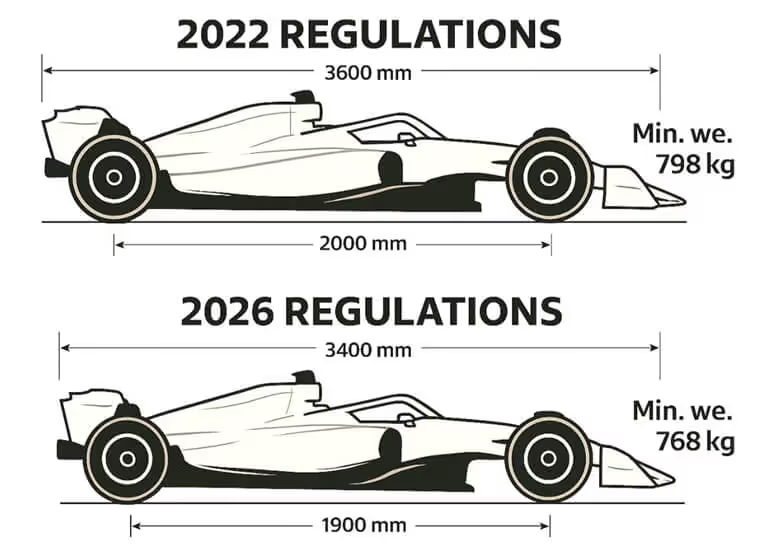
Remember when your mom told you to stop eating samosas and hit the gym? Well, the FIA just told Formula 1 cars the exact same thing. And honestly? They needed it.

The 2026 F1 season is bringing massive changes to how these machines look and perform, and I'm here to break down what's actually happening without the boring technical jargon. Spoiler alert: these new cars are going to be smaller, lighter, faster, and way more fun to watch race.We all see those sleek F1 cars zooming around at 300+ km/h looking absolutely gorgeous on the track. But have you ever wondered how teams actually get those stunning paint jobs on their race cars?

It's not just about grabbing a paint brush and going "vaish vaish" like you might do on your scooter back home. Buckle up – we're about to dive into the surprisingly complex world of Formula 1 car painting!

The Big Picture: F1 Livery is Way More Than Just Paint

Here's the thing: those distinctive designs you see on F1 cars aren't just there to look pretty (though they absolutely do). Every F1 livery is basically a mobile billboard that travels the globe, promoting sponsors and representing team identity. It's like your neighborhood's dhaba finally got a professional logo design – except this logo costs millions and goes 340 km/h.

At Alpine's paint shop in Enstone, England, a dedicated team of 10 professionals work year-round to make sure those cars look absolutely mint. And trust us, the process is way more intricate than you'd think.

Part 1: The Design Phase – Where the Magic Starts

Before a single drop of paint hits a carbon fiber chassis, the design and marketing teams spend months – sometimes over a year – dreaming up the livery. They're not just throwing colors together randomly (though that's what it sometimes looks like when you're watching from the stands).

What goes into this brainstorming session?

  • The team's brand identity (think of it like creating a unique personality for the car)
  • Sponsor requirements (because let's be honest, sponsors are basically running the show)
  • How the design will look in-person at the track
  • How it'll look on TV screens across India and the world
  • What the design looks like from different angles and under various lighting conditions

The designs are tested extensively on digital screens to ensure they pop on television. Why? Because millions of F1 fans watching from home are part of the equation. If your livery doesn't look good on a 2D screen, you've basically failed the entire exercise.

Watch How Red Bull Racing Team Paints Their F1 Car

(Video Courtesy - Red Bull Racing Team)

Part 2: From Digital Dreams to Physical Reality

Once the design is finalized, the real work begins. The paint shop receives the initial renders and has to figure out one critical question: How do we actually paint this thing?

"We have some test panels, and we learn as we go," explains Alpine's Head of Supply Chain, Ian Pearce. "We're trying to achieve the right color with the lightest possible weight. Every gram matters in F1!" (read that again, "every gram matters")

Here's where it gets interesting (and slightly chaotic): F1 cars aren't solid objects. They're made of individual panels that fit together. Sometimes the design looks perfect on a computer, but when you try to paint it across actual car panels with split lines and joins, things get... complicated.

The panel problem: Imagine trying to draw a straight line across multiple pieces of paper without them matching up perfectly. That's what the paint team deals with daily. If panels don't line up correctly, fans and TV cameras will spot it immediately. It's basically the F1 equivalent of a failed home paint job where you can see all the mistakes from across the room.

Part 3: The Paint Shop Chronicles – Breaking Down the Process

This is what actually happens when panels arrive at the shop:

Step 1: Preparation (aka the boring but crucial stuff)

First, they receive bare carbon fiber panels – basically unpainted, naked components. The team has to:

  • Mask out areas that will stay bare carbon (yes, modern F1 cars intentionally leave sections unpainted to save weight)
  • Fill any imperfections with black composite filler
  • Sand everything until it's smooth (using 320-grit, then 500 or 800-grit paper)

It's like preparing your walls before painting your flat. You can't just slap paint on imperfections and hope nobody notices.

Step 2: The Primer Treatment

  • Two-pack primer is applied
  • Everything gets rubbed down again with 320-grit paper
  • Then finer sanding with 500 or 800-grit paper (because tiny scratches ruin everything)

Step 3: The Actual Paint

  • Two coats of metallic base coat (the fun part!)
  • One coat of matte lacquer

And boom – you've got a painted F1 car component.

Part 4: The Vinyl Wrap Revolution – Modern F1's Better Idea

Here's where Alpine innovated: instead of just painting everything, they largely switched to vinyl wraps.

Why? Simple: weight savings.

In Formula 1, every single gram matters. Paint adds weight. Vinyl wraps add weight too, but they add weight more consistently throughout the season. With paint, teams were continuously adding weight as they refreshed and repainted components. Vinyl solves this problem.

But here's the catch: Vinyl wrapping is actually MORE demanding than painting.

"With paint, you can hide imperfections," Pearce explains. "With vinyl, you absolutely cannot. Every tiny flaw in the underlying carbon fiber shows through. It's like wearing a tight t-shirt when you're not exactly gym-ready – everything becomes visible!"

The vinyl has to fit perfectly against the carbon fiber contours. It's precision work at a microscopic level. One misaligned section, and your multi-million-dollar F1 car looks unprofessional on TV. No pressure, right?

Part 5: The Temperature Nightmare – Vegas vs Qatar

Here's something nobody talks about: ambient temperature destroys F1 paint jobs.

The Vegas problem: It's 6°C at night in Las Vegas. When technicians try to apply vinyl in such cold conditions, the backing paper basically turns to "jelly," The adhesive doesn't work properly. Everything becomes a nightmare.

The Qatar problem: It's 30°C. The vinyl becomes too sticky and difficult to apply precisely.

It's like trying to make perfect rotli at high altitude in Himachal – conditions matter way more than you'd expect.

The paint shop has to constantly adapt their techniques based on local conditions at each Grand Prix venue. They can't just apply the livery in the controlled factory environment and hope it works worldwide.

How To Design An F1 Livery

(Video Courtesy -Mr. V's Garage)

Part 6: Special Liveries – The Fun (but Stressful) Part

Remember when Alpine ran a Deadpool-themed livery at the Belgian Grand Prix in 2024? Or the Indiana Jones design at the US Grand Prix? These one-off liveries are marketing gold but logistical nightmares.

"Spa was a nightmare from a practical standpoint," Pearce admits. "You've got three options of front wings, three options of rear wings, four options of cooling bodywork... and they ALL have to be wrapped in the special livery."

Why? Because if it rains during practice but you've only wrapped the dry-weather setup, you're stuck. The engineers might need a different cooling configuration, but it won't match the livery. Unacceptable.

So the paint team has to prepare every single possible configuration. For one race. In a unique color scheme. This is the definition of "over the top" – but this is F1, so it's basically business as usual.

Part 7: The Never-Ending Refresh Cycle

Here's the thing nobody realizes: F1 paint jobs aren't just done once. They're refreshed constantly throughout the season.

Why? Aerodynamic damage and wear.

During a race, the leading edges of wings get sandblasted by dirt and stones. By race end, the vinyl is peeling, scratched, and damaged. Not only does this look terrible, but it destroys aerodynamic efficiency. So before the next race, the entire livery gets stripped and replaced.

This happens every few Grand Prix races. Which means the paint shop is traveling around the world constantly, replacing liveries at circuits. It's cheaper to do this at the track than to ship panels back to England.

"Some parts of the car get absolutely sandblasted," Pearce explains. "Especially at dusty circuits like Bahrain and Qatar. The vinyl acts as a protective layer for the carbon fiber underneath. Once that's gone, you risk damaging the actual car components."

Part 8: The Secret Garage – Show Cars and Launch Cars

Before a new season launches, everything is kept secret. The paint shop wraps show cars in the new livery, but these can't be seen until the official launch. They're covered up like they're hiding state secrets.

"Everything needs to be kept covered – even from people here at the factory – because it's all top secret," Pearce says. "We can't show anything in the old livery once the new livery has launched. No exceptions."

This means the paint team is simultaneously working on race cars, spare parts, pit equipment, factory equipment, tool boxes, and show cars – all in different stages of production, all needing precision work, and all requiring absolute secrecy until launch day.

It's like preparing for a giant surprise party, except the surprise is a 1000-horsepower race car, and the consequence of leaking details is millions of rupees in lost marketing value.

Part 9: The Weight Question – Why Bare Carbon Exists

You might wonder why modern F1 cars have all that bare carbon fiber showing. It's not a design choice; it's physics.

The 2005 championship-winning Renault R25 was painted almost entirely. Beautiful. But modern F1 is obsessed with weight reduction. Every gram saved = potential advantage. Alpine's 2024 car launched overweight and gradually got lighter as the season progressed – with more paint being added back as weight was saved elsewhere.

It's a constant balancing act: Look beautiful on TV vs. Stay lightweight for performance.

Guess which one usually wins? Yep, the lightweight option.

Part 10: The 2026 Challenge – New Regulations, New Headaches

Formula 1 is introducing three pre-season tests in 2026 instead of the usual schedule. This means the off-season gets shorter. The paint team has to front-load their work into December instead of January.

Pearce is already stressed about this, and the regulation change hasn't even happened yet. It's like being told you need to paint your house, but you've got 30% less time – and the paintwork has to be flawless for a TV broadcast.

The Bottom Line: Why F1 Paint Jobs Are Insanely Complicated

At the end of the day, painting an F1 car isn't just about making it look pretty. It's about:

  • Balancing weight requirements with visual impact
  • Ensuring consistency across dozens of components
  • Handling temperature extremes across three continents
  • Managing sponsor requirements and brand identity
  • Protecting aerodynamic surfaces from damage
  • Keeping everything secret until launch day
  • Maintaining equipment and show cars year-round
  • Constantly refreshing liveries to maintain performance and aesthetics

It's precision engineering meets artistic vision meets logistical chaos.

Pearce sums it up best: "The one-off liveries were amazing. To see that design come to life and then see it go around the track? Yeah, it's totally amazing. Even when you're flipping the car backwards and forwards during the process, it's just a massive achievement."

So next time you're watching an F1 race on your screen, take a moment to appreciate those gorgeous liveries.

There's a whole team of dedicated technicians working year-round, traveling the world, and dealing with impossible challenges to make sure those cars look absolutely stunning – even if nobody fully realizes what goes into it.

Because in Formula 1, even the paint job is an engineering masterpiece. Welcome to the high-octane world of F1 paint shops – where precision, perfection, and a little bit of controlled chaos create rolling works of art that do 300+ km/h.

Want to know more about F1? From car design to pit strategy, we've got all the details that make Formula 1 the most fascinating sport on the planet.

Stay tuned for more insider looks at how teams push the boundaries of speed and technology!

Watch How F1 Cars Are Painted

(Video Courtesy - F1 Education)

How Do They Paint A Formula 1 Car?

Buckle up – we're about to dive into the surprisingly complex world of Formula 1 car painting!

Blog Image
January 19, 2026
3
min read
Technology

Remember when your mom told you to stop eating samosas and hit the gym? Well, the FIA just told Formula 1 cars the exact same thing. And honestly? They needed it.

The 2026 F1 season is bringing massive changes to how these machines look and perform, and I'm here to break down what's actually happening without the boring technical jargon. Spoiler alert: these new cars are going to be smaller, lighter, faster, and way more fun to watch race.

How Much Smaller Are We Actually Talking About?

Imagine your favorite F1 car going on a crash diet. The new 2026 regulations have slashed the wheelbase (that's the length, for the non-gearheads) by 200mm. To put this in perspective, that's about the size of your average reusable water bottle – the one you bought to feel eco-conscious but only used twice before going back to plastic.

The width has been trimmed by 100mm too (roughly the length of a chocolate bar, which honestly sounds like the most F1 way to measure anything), bringing it down to 1900mm. Even the floor width got a trim of 150mm. These cars are basically going full-minimalist aesthetic now.

The bottom line? 2026 F1 cars will be more agile, easier to maneuver, and less like trying to park a bus in Mumbai traffic.

Watch 12 Things You Need To Know About F1's 2026 Rules Revolution

(Video Courtesy - The Race)

The Weight Loss Journey: From Chubby to Fit

Here's where it gets really interesting. The FIA managed to shed a whopping 30kg from these machines compared to 2022 models. That's equivalent to removing an adult dalmatian from the car – which is a very specific way to measure weight, but we're rolling with it.

The new cars will weigh just 768kg total (722kg car + 46kg tyres estimated). If F1 cars were trying to get in shape for a Bollywood movie, this would be their big transformation moment.

Why does this matter? Lighter cars mean better acceleration, sharper handling, and a whole lot more racing action. Less mass to throw around = more precise driver control. Think of it like the difference between driving a fully-loaded SUV and a lightweight hatchback through Bangalore traffic.

The Downforce and Drag Trade-Off

The engineers have been pretty clever here. They've cut downforce by 30% and reduced drag by 55%. Now before you think "less grip = slower cars," that's not quite how it works.

The goal is efficiency and handling – basically making cars that stick around better when they're close together without creating this massive invisible bubble of air that makes overtaking impossible. It's like finally being able to follow that car in front of you without feeling like you're trying to push through a wall of invisible force.

What About the Tyres? Are They Changing Too?

Good news and bad news situation here. The 18-inch wheels that were introduced in 2022 are sticking around (so no radical changes there). But there are some tweaks that matter.

Front tyres are 25mm narrower and rear tyres are 30mm narrower. This will reduce weight slightly, and according to Pirelli, there will be "minimal loss" of grip. Translation: the tyres will still grip like they mean it, they'll just do it while being lighter and more efficient.

Mario Isola, the Pirelli motorsport boss, mentioned they're expecting to save around 5kg per set of four tyres. That might not sound like much, but in F1, every gram counts. It's like saving 5kg in groceries on your monthly bill – small wins add up.

The Cool Bit: X-Mode and Z-Mode Active Aerodynamics

Now, this is where things get genuinely exciting. Remember the DRS system that lets drivers open their rear wing on straights? Imagine that but on steroids.

The 2026 F1 cars will have movable front and rear wings that drivers can actually control during the race. Here's how it works:

Z-Mode (Standard Setup): The wing elements open and angle themselves to give the car maximum downforce. This is your high-grip, high-speed-corner mode. The car will be a proper racing machine in this mode.

X-Mode (Low-Drag Setup): The flap angles change on both front and rear wings to maximize straight-line speed. Drivers activate this on straights to gain that precious extra speed without losing their minds about aerodynamic instability.

The FIA is planning to make X-mode available on any straight that lasts longer than three seconds. This isn't just a gimmick either – it genuinely should help with overtaking because cars won't be creating that wall of turbulent air that makes following nearly impossible.

Real talk? This is basically F1 finally admitting that having cars follow each other more easily might actually make racing better. Revolutionary, I know.

Other Aerodynamic Tweaks That Actually Matter

The FIA isn't just stopping at active wings. They're also removing front wheel arches entirely and mandating specific wheel bodywork to improve "wake performance." Basically, they're trying to clean up the messy air that comes off the wheels so the car behind can actually breathe.

There will also be in-washing wheel wake control boards on the front of the sidepods. Yes, that's a real name. No, I don't fully understand it either, but apparently it helps control the air coming off the wheels.

The floor is going "partially flat" and the diffuser is getting less power. This is the FIA's way of saying "let's make the ground effect less crazy so teams aren't struggling with bouncing and porpoising like they're riding a mechanical bull at a nightclub."

Safety Gets the Spotlight Too

Let's not forget that F1 cars also need to, you know, protect the driver if something goes wrong.

The FIA has redesigned the front impact structure with a two-stage setup to prevent the FIS from snapping off near the survival cell during crashes. Side intrusion protection around the cockpit has been beefed up, and the protection around the fuel cell has more than doubled.

Best part? They did all this without adding any weight. That's some seriously smart engineering right there.

Roll hoop loads have been bumped from 16G to 20G (matching other single-seater formulas), and test loads have increased by 26kN to 167kN. There's also new lateral safety lights to show the ERS (Energy Recovery System) status when a car stops on track, helping protect both drivers and marshals.

So What Does This All Mean for Racing?

The 2026 regulations are basically F1's way of saying "let's make racing actually exciting again." Smaller cars that are easier to handle, more efficient aerodynamics that don't create walls of dead air, and movable wing elements that give drivers more tools to overtake.

These aren't revolutionary changes – they're evolutionary improvements aimed at one thing: letting drivers race each other more closely and actually pass each other without it being a complete lottery.

The verdict?

2026 should be pretty interesting. The cars might be smaller on the outside, but they're getting smarter on the inside. And really, isn't that what we all want – a more agile, efficient machine that's actually fun to watch?

Time to mark your calendars for 2026. This is going to be good.

What's Really Changing? - F1 2026 Regulations

(Video Courtesy - Formula Addict)

2026 F1 Regulations Explained

The new cars are going to be smaller, lighter, faster, and way more fun to watch race

Speak with our F1 Travel Expert.
No commitments.
Just coffee & conversation.

Follow us on Instagram

insta
insta
Close-up of a red Ferrari Formula 1 race car steering wheel inside the cockpit with various buttons and MOMO branding.
insta
insta
cross